Artificial intelligence can complete tasks in seconds that would previously have taken employees hours. It can summarise documents, analyse information, draft customer responses, classify data and identify patterns across large datasets. That speed creates obvious opportunities for businesses, but it also introduces a simple risk: an answer can be produced quickly without necessarily being correct. NIST’s AI Risk Management Framework therefore treats reliability, safety, transparency, accountability and the management of harmful bias as important characteristics of trustworthy AI systems rather than assuming that technical capability alone is enough.
AI Output Can Look More Certain Than It Is
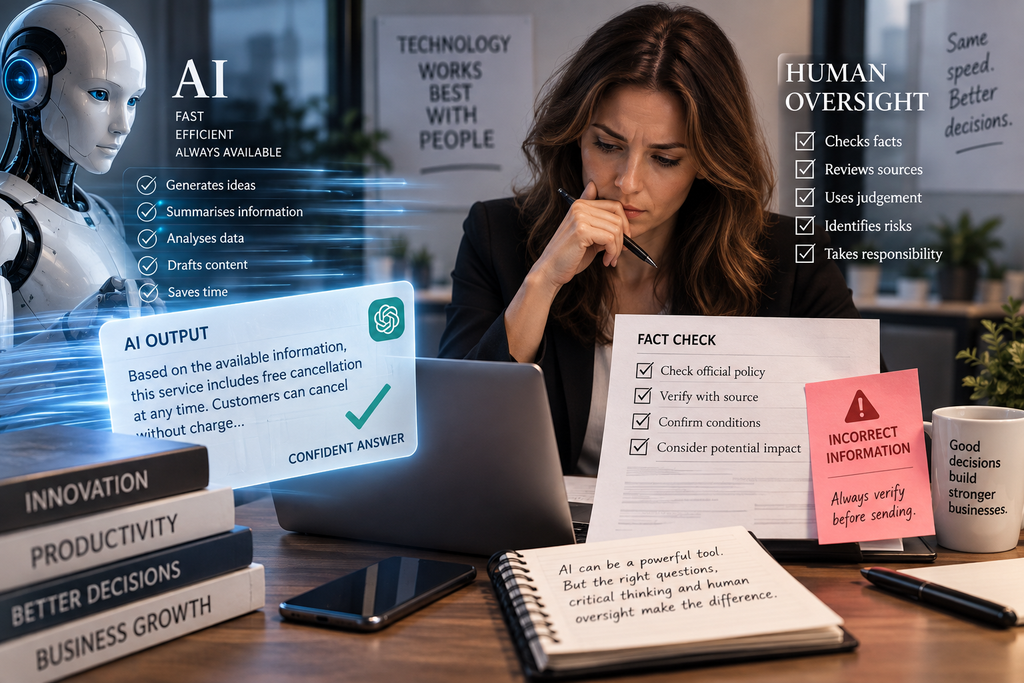
One of the difficulties with generative AI is that an incorrect answer may still sound professional and convincing. An employee reading a badly written report will often notice something is wrong immediately, but an AI-generated response can be clearly structured, grammatically correct and still contain inaccurate information. This creates a particular risk when employees begin trusting the presentation of an answer rather than checking the evidence behind it. NIST’s Generative AI Profile specifically provides organisations with guidance for identifying and managing risks associated with generative AI rather than treating generated output as automatically reliable.
Example: The Customer Gets the Wrong Answer
Imagine a company uses AI to draft customer-service responses. A customer asks whether a particular service includes cancellation without charge, and the AI produces a confident response saying that it does. The employee sends the answer without checking the actual terms, but the policy contains several conditions that the AI has missed. What looked like a productivity improvement has now created a complaint, additional administration and potentially a financial cost.
The solution is not necessarily to stop using AI. The system can still prepare the first draft and reduce the amount of routine writing required. The important difference is that employees need to know which answers can be accepted quickly and which require verification against an authoritative source.
The Higher the Risk, the More Important the Review
Not every AI-generated output requires the same level of scrutiny. Using AI to suggest alternative wording for a marketing headline carries very different consequences from using it to support decisions about finance, recruitment, legal obligations or customer eligibility. Businesses therefore need to consider the potential impact if the AI is wrong rather than applying one approval process to every use case.
The UK government’s guidance on AI assurance describes assurance as a way of providing confidence that AI systems operate appropriately and that risks are identified and managed throughout their lifecycle. It places AI assurance within wider governance arrangements rather than treating it as a one-off technical check before deployment.
Human Oversight Should Mean More Than Clicking “Approve”
Businesses can claim that a person reviews AI output while still providing very little genuine oversight. If an employee is expected to approve hundreds of AI-generated decisions every day, they may eventually begin accepting them automatically. Human review only adds value when the reviewer has enough information, knowledge and time to recognise when something looks wrong.
This means businesses should decide who is responsible for checking different types of AI output, what information they should compare it against and when a case needs to be escalated. NIST’s AI risk-management work highlights human-AI interaction and human oversight as areas requiring careful design because the effectiveness of oversight depends partly on how people understand and interact with AI-generated information.
Example: AI Finds a “Problem” in the Numbers
A manager uploads sales data into an AI tool and asks why revenue declined during the previous month. The system produces a convincing explanation involving declining customer demand and poor marketing performance. However, one major client invoice was simply recorded in the following accounting period. Without checking the underlying data, management could respond to a business problem that does not actually exist.
AI can help generate hypotheses and identify unusual patterns, but the analysis still needs to be connected to verified business data. A useful explanation based on incomplete information can still lead to the wrong decision.
Automation Can Scale Mistakes as Well as Efficiency
The advantage of automation is that it allows an organisation to perform large numbers of tasks quickly and consistently. Unfortunately, the same characteristic applies when something is wrong. A person making one incorrect decision creates one problem; an automated process using the same incorrect rule can create hundreds or thousands before anyone notices.
That is why monitoring should continue after implementation. NIST’s AI RMF is organised around the functions Govern, Map, Measure and Manage, with risk management treated as a continuous activity throughout the AI lifecycle rather than something completed once before a system is launched.
For businesses, this can mean reviewing error rates, customer complaints, unusual outcomes and cases where employees repeatedly override AI recommendations. Those signals can reveal that the system, its data or the process around it needs improvement.
Employees Need to Know When Not to Trust the Tool
Introducing AI without explaining its limitations can create a false sense of security. Employees may assume that because the organisation has approved a particular system, its answers are safe to use without further checking. Training therefore needs to cover more than how to write prompts or access the tool; employees should also understand what information may be unreliable, what data should not be entered and when human judgement is required.
The UK government has increasingly emphasised AI assurance as a capability businesses will need if they want to adopt AI with confidence. Its 2025 roadmap for third-party AI assurance describes trustworthy adoption as important to capturing the economic benefits of AI while helping organisations manage associated risks.
Oversight Does Not Have to Remove the Productivity Benefit
Human oversight does not mean employees must manually repeat everything the AI has already done. That would remove much of the value of automation. Instead, businesses can design different levels of review according to risk: low-impact content may require only occasional sampling, important customer communications may require approval before sending, and high-impact decisions may require both human review and supporting evidence.
The objective is to determine where automation can safely operate independently and where human judgement adds necessary protection. A sensible system can still save considerable time while ensuring that employees remain accountable for decisions where mistakes would have meaningful consequences.
The Best AI Process Combines Speed With Responsibility
Businesses should not have to choose between human judgement and AI. The strongest operating model often uses both for what they do well. AI can process large quantities of information, perform repetitive tasks and generate possible answers quickly, while people provide context, question unusual results, interpret consequences and take responsibility for decisions.
The value of AI therefore should not be measured only by the number of tasks automated or the number of hours theoretically saved. Businesses should also ask whether the outputs are accurate enough for their purpose, whether mistakes can be detected, whether employees understand when intervention is required and whether someone is clearly responsible when the system produces an unexpected result.
AI can make businesses faster. Human oversight helps ensure that faster does not also mean faster in the wrong direction.
Category: AI & Technology
Sources
National Institute of Standards and Technology — AI Risk Management Framework 1.0 and the NIST AI RMF Playbook, providing a voluntary framework for governing, mapping, measuring and managing AI risks.
NIST — Artificial Intelligence Risk Management Framework: Generative Artificial Intelligence Profile, addressing risks specifically associated with generative AI systems.
UK Government / Department for Science, Innovation and Technology — Introduction to AI Assurance, explaining approaches for building confidence in the safe and responsible development and deployment of AI.
UK Government — Trusted Third-Party AI Assurance Roadmap (2025), setting out the UK’s approach to strengthening AI assurance capabilities and trusted adoption.