Artificial intelligence has quickly moved from being a specialist technology to something almost any business can access. A small company can now use AI to draft documents, analyse information, respond to customers, summarise meetings, create marketing content or automate repetitive administrative work without building its own technology department.
Adoption is growing quickly. OECD data published in 2026 shows that 20.2% of firms across countries with available data reported using AI in 2025, compared with 14.2% in 2024 and 8.7% in 2023. But the gap between large and small companies remains substantial: 52% of large firms reported using AI compared with 17.4% of small firms. (OECD)
The opportunity for smaller businesses is therefore significant, but so is the risk of adopting AI simply because everyone else appears to be doing it.
The important question is not “How can we use AI?”
It is “Where can AI create measurable value in this business?”
Start With Work, Not With Technology
A common mistake is beginning with an AI tool and then looking for something to do with it. A better approach is to examine how work currently happens.
Where are employees repeating the same task? Where does information need to be copied from one system to another? Which activities consume significant time without requiring much judgement? Where are customers waiting because employees are overloaded?
These areas are often better candidates for AI than highly complex strategic decisions.
For example, a consultancy may spend hours summarising meetings and preparing initial reports. A retailer may repeatedly answer the same customer questions. A property business may process large numbers of similar enquiries. A small professional-services company may need to extract information from documents and organise it before an employee reviews it.
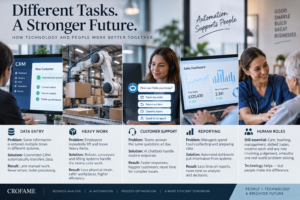
AI can reduce the manual work involved in all of these activities without necessarily replacing the person responsible for the final decision.
Administrative Work Is Often the Easiest Starting Point
Some of the most practical uses of AI are not particularly dramatic.
Meeting summaries, first drafts of emails, document classification, information extraction, basic reporting and internal knowledge searches may not attract headlines, but they can save employees significant amounts of time.
This matters particularly for small businesses because employees often perform several roles at once. A founder may be responsible for sales, administration, marketing and customer communication. Removing even a few repetitive tasks can release capacity for work that has greater commercial value.
OECD research on SMEs notes that generative AI can help smaller businesses address labour and skills constraints, although businesses still face barriers including skills, data, finance and digital readiness. (OECD)
The objective should not necessarily be to automate an entire job. Often the greater benefit comes from removing small pieces of repetitive work from many different jobs.

Customer Service Can Improve — but Only With Good Boundaries
Customer support is another obvious area for AI. Businesses can use automated systems to answer common questions, categorise enquiries, draft responses or direct customers to the correct information.
This can improve response times, particularly outside normal working hours.
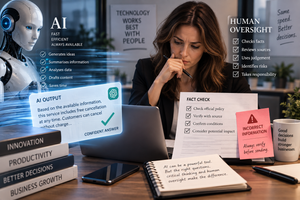
But customer service also demonstrates why automation needs boundaries. A chatbot that confidently gives the wrong information can create more work rather than less. Customers dealing with complaints, financial issues or unusual situations may become frustrated if they cannot reach a person.
The stronger model is often AI first, human when necessary.
AI handles repetitive enquiries and prepares information. Employees deal with exceptions, complaints, negotiations and situations requiring judgement.
That allows technology to increase capacity without removing the human element where it actually matters.
Marketing Is Accessible — but Easy to Overuse
Marketing has become one of the easiest ways for smaller companies to experiment with generative AI. OECD research indicates that among firms already using AI, smaller enterprises have been particularly active in marketing and sales applications. (OECD)
The attraction is obvious. AI can generate social-media drafts, product descriptions, advertising variations, email campaigns and content ideas within seconds.
However, easy content generation creates a different problem: volume is not the same as quality.
If every company uses similar tools with similar prompts, marketing can quickly become repetitive and generic. Businesses may publish more while saying less.
AI works better when it supports a clear brand strategy rather than replacing one. It can accelerate research, generate alternatives and help with initial drafts, but businesses still need to decide what they want to communicate, who they are trying to reach and why customers should care.
The technology makes producing content easier. It does not automatically make the content useful.
AI Can Help Analyse Information, but It Should Not Become the Decision-Maker
Businesses are also beginning to use AI to work with data, reports and documents. It can identify patterns, summarise large quantities of information and help managers explore possible explanations.
This can make analysis more accessible to organisations that do not have large specialist teams.
But AI-generated analysis should still be checked against reliable business data.
A confident answer is not necessarily an accurate answer. If the underlying information is incomplete, outdated or poorly structured, AI may produce an impressive explanation of the wrong situation.
This is particularly important when decisions affect finances, employees, customers or legal obligations.
The useful role for AI is often to support analysis rather than replace accountability. It can help identify questions, organise evidence and compare possibilities. A human decision-maker should still understand the evidence behind the final recommendation.
Bad Processes Do Not Become Good Processes Because They Use AI
Automation can also make inefficient processes happen faster.
Imagine an organisation has a complicated approval process requiring employees to enter the same information into three systems. Adding AI may reduce some manual typing, but it does not answer the more important question: Why does the information need to be entered three times in the first place?
Sometimes the correct solution is not AI. It may be simplifying the process, removing unnecessary approvals, integrating existing systems or changing responsibilities.
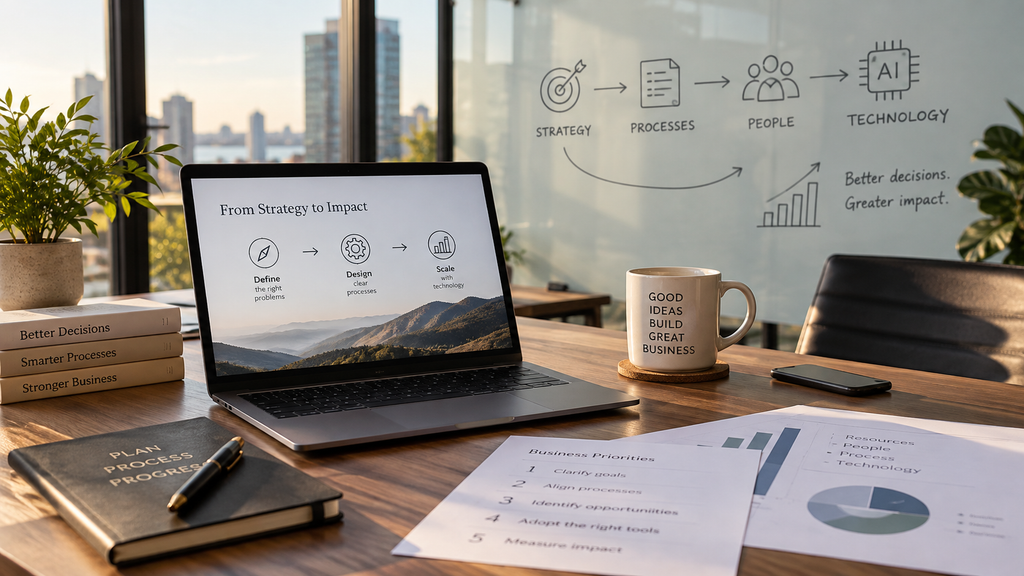
This is why process analysis should come before automation.
Technology should support a process that makes sense. Otherwise, a business may spend money automating activities that should have been removed altogether.
Small Businesses Do Not Need AI Everywhere
The rapid growth of AI can create pressure to adopt it across the organisation. But not every task benefits from automation.
A small company may gain considerably more value from improving one high-volume administrative process than from introducing AI into ten different departments.
Some activities are already efficient. Others happen too rarely for automation to justify the effort. Certain tasks depend heavily on relationships, negotiation, creativity or specialist judgement.
The question is not whether AI can perform part of a task. Increasingly, it probably can.
The question is whether using it creates enough benefit to justify the additional technology, supervision, training and risk.
Skills Are Becoming Part of the AI Investment
Buying access to an AI platform is relatively easy. Using it well is harder.
OECD research published in 2026 identifies skills shortages as a major barrier to adoption. More than half of SMEs not yet using generative AI reported that skills were an important constraint. (OECD)
This means AI investment is partly a people investment.
Employees need to understand what the tools can do, when their outputs need checking and what information should not be entered into external systems. Managers also need enough knowledge to identify realistic opportunities rather than approving technology because of exaggerated expectations.
A business that buys several AI products without developing these capabilities may simply create another collection of underused subscriptions.
Measure the Result, Not the Excitement
The strongest AI projects should be measurable.
If AI is introduced into customer service, has response time improved? If it is used for administration, how many working hours are being saved? If it supports marketing, has the cost of producing campaigns fallen or have conversions improved? If it assists with document processing, has error reduction justified the investment?
Without a baseline, businesses can easily convince themselves that a new tool has improved productivity simply because employees are using it.
This is especially important as vendors increasingly promise major efficiency gains.
Microsoft-commissioned research published in 2025 estimated that wider AI adoption by UK SMEs could contribute £78 billion in additional economic value over a decade. The figure illustrates the scale of the potential opportunity, but individual businesses still need to demonstrate value within their own operations rather than assume economy-wide estimates will automatically apply to them. (Microsoft UK Stories)
The Competitive Advantage May Come From Integration, Not the Tool
Most businesses will eventually have access to similar AI capabilities. Competitive advantage is therefore unlikely to come simply from owning an AI subscription.
The difference may come from how effectively organisations integrate those tools into their processes.
A company that understands its workflows, has reliable data and trains its employees can use AI to remove friction and improve decisions. Another company can purchase exactly the same technology and gain very little because its processes remain unclear and employees do not trust or understand the system.
This is also why AI adoption tends to be connected with broader digital maturity. OECD research highlights connectivity, data, skills, computing capability and finance as important foundations for successful SME adoption. (OECD)
AI does not eliminate the need for good business foundations. In many cases, it makes their importance even more visible.
The Best AI Strategy May Be Surprisingly Simple
Small businesses do not need an AI transformation programme involving dozens of tools.
A more practical approach is to identify one recurring problem, understand the current process, estimate how much time or money it consumes and test whether AI can improve it.
If the result is measurable, expand. If it creates new complexity without meaningful benefit, stop.
The businesses that gain the most from AI may not be those using the largest number of tools. They may be the organisations that are most disciplined about deciding where technology is useful, where human judgement remains essential and where no technology is needed at all.
AI can create substantial value.
But the value does not come from AI itself.
It comes from using it to solve the right problem.
Category: AI & Technology
Sources: OECD — AI Use by Individuals Surges Across the OECD as Adoption by Firms Continues to Expand (2026); OECD — AI and Skills (2026); OECD — AI Adoption by Small and Medium-Sized Enterprises (2025); OECD — Generative AI and the SME Workforce (2025); OECD/BCG/INSEAD — The Adoption of Artificial Intelligence in Firms (2025); Microsoft & WPI Strategy — Unlocking Regional Growth: The Impact of AI Adoption by SMEs (2025). (OECD)