Anna

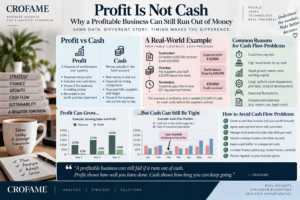
Profit Is Not Cash: Why a Profitable Business Can Still Run Out of Money

A business can be profitable on paper and still struggle to pay wages, suppliers or rent. Profit measures whether revenue exceeds costs over a period, while cash flow measures when money actually enters and leaves the bank account. The British Business Bank warns that even profitable businesses can experience serious cash-flow problems when they incur

Profit Is Not Cash: Why a Profitable Business Can Still Run Out of Money Read More »

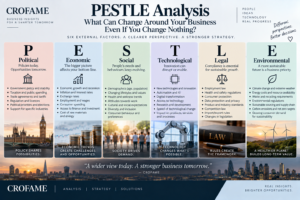
PESTLE Analysis: What Can Change Around Your Business Even If You Change Nothing?

A business can make good internal decisions and still be affected by events completely outside its control. Interest rates change, customer behaviour shifts, new technology appears, regulations are introduced and environmental pressures influence costs and expectations. PESTLE analysis helps businesses examine these external forces before they become operational problems or missed opportunities. PESTLE stands for

PESTLE Analysis: What Can Change Around Your Business Even If You Change Nothing? Read More »

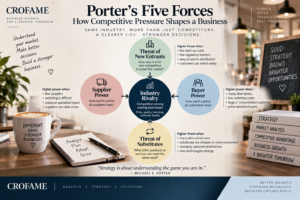
Porter’s Five Forces: How Competitive Pressure Shapes a Business

A business does not compete only with companies selling the same product. Its profitability can also be affected by suppliers, customers, new competitors and alternative products that solve the same problem in a different way. Michael Porter’s Five Forces framework was designed to help businesses look at this wider competitive environment and understand where pressure

Porter’s Five Forces: How Competitive Pressure Shapes a Business Read More »

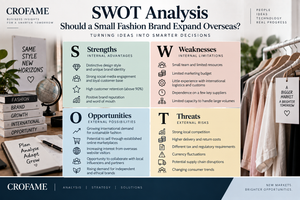
How SWOT Analysis Helps Businesses Make Better Decisions

SWOT analysis is one of the simplest strategic tools a business can use to understand its position before making an important decision. It looks at four areas: Strengths, Weaknesses, Opportunities and Threats. Strengths and weaknesses are internal factors the business can influence, while opportunities and threats come from the external environment. Used properly, SWOT helps

How SWOT Analysis Helps Businesses Make Better Decisions Read More »

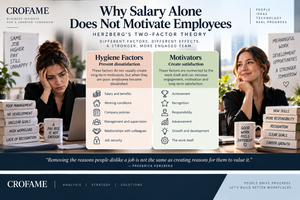
Why Salary Alone Does Not Motivate Employees: Herzberg’s Two-Factor Theory

A pay rise can make an employee happier, but it does not automatically make the job more interesting, improve a poor manager or create opportunities for development. This is the central idea behind Herzberg’s Two-Factor Theory, one of the best-known theories of workplace motivation. Frederick Herzberg argued that the factors causing dissatisfaction at work are

Why Salary Alone Does Not Motivate Employees: Herzberg’s Two-Factor Theory Read More »

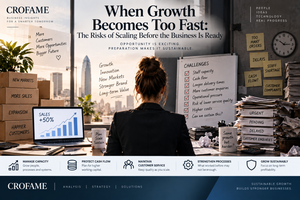
When Growth Becomes Too Fast: The Risks of Scaling Before the Business Is Ready

Rapid growth is usually treated as a success. More customers, higher sales and larger contracts can all suggest that a business is moving in the right direction. But growth can also expose weaknesses that were manageable when the company was smaller. If sales increase faster than staffing, systems, cash flow or operational capacity, the business

When Growth Becomes Too Fast: The Risks of Scaling Before the Business Is Ready Read More »

Innovation Does Not Always Mean Inventing Something New

Innovation is often associated with breakthrough inventions, new technologies or completely new products. In practice, a business can innovate without inventing anything from scratch. It may change how a product is sold, how customers receive a service, how employees complete a process or how the company generates revenue. The OECD defines business innovation broadly as

Innovation Does Not Always Mean Inventing Something New Read More »

Why Some Businesses Grow Faster Than Others

Some businesses grow quickly while others remain almost the same size for years. The difference is not always the quality of the original idea. Growth usually depends on a combination of demand, management capability, access to finance, productivity, innovation and the ability to turn opportunities into repeatable business activity. OECD research on scaling firms shows

Why Some Businesses Grow Faster Than Others Read More »

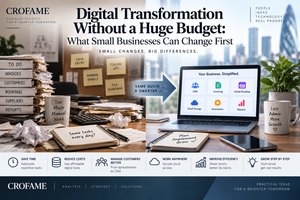
Digital Transformation Without a Huge Budget: What Small Businesses Can Change First

Digital transformation does not have to begin with a large software project, consultants or an expensive custom platform. For many small businesses, the best starting point is simply replacing repetitive manual work with affordable digital tools that solve one clear problem at a time. This matters because cost, time and uncertainty are among the biggest

Digital Transformation Without a Huge Budget: What Small Businesses Can Change First Read More »

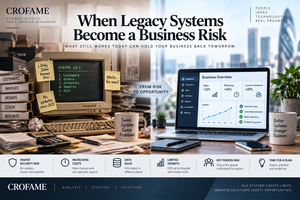
When Legacy Systems Become a Business Risk

Older technology is not automatically bad technology. Many businesses continue using systems that were introduced years ago because they still perform the job they were designed to do. The problem begins when a system becomes difficult to maintain, no longer receives security updates, cannot connect with newer software or forces employees to create manual workarounds.

When Legacy Systems Become a Business Risk Read More »

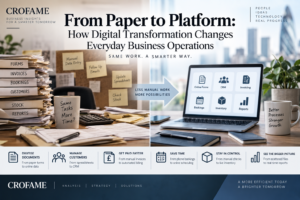
From Paper to Platform: How Digital Transformation Changes Everyday Business Operations

Digital transformation does not have to begin with artificial intelligence, robotics or a large technology programme. For many businesses, it starts with something much simpler: replacing paper forms, spreadsheets, manual bookings and repeated data entry with connected digital systems that make everyday work faster and easier to manage. This matters because small inefficiencies accumulate. A

From Paper to Platform: How Digital Transformation Changes Everyday Business Operations Read More »

Shopping Cart