
Which Jobs Can Technology Replace — and Where Will People Still Be Needed?
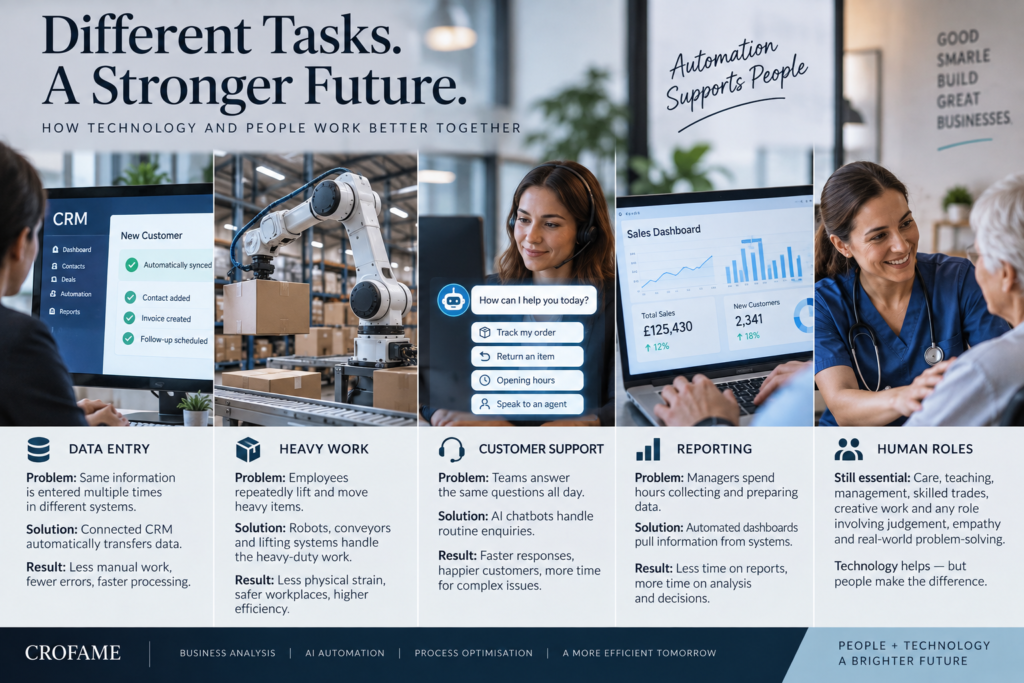
Automation does not affect every job in the same way. Some tasks can already be completed almost entirely by software or machines, while others are more likely to become faster and easier with AI support. The International Labour Organization estimates that one in four workers globally is in an occupation with some exposure to generative AI, but says job transformation is more likely than complete replacement in most cases. (International Labour Organization)
Problem: Data Entry Mess
A customer completes an online form, but an employee then copies the same name, address and order details into Excel, a CRM and an invoicing system. This is repetitive work that creates opportunities for mistakes. Solution: connected CRM and accounting systems can capture the information once and transfer it automatically. The employee is only needed when information is missing or an unusual case appears.
This type of clerical work is among the areas most exposed to automation. The World Economic Forum lists data-entry clerks, bank tellers, cashiers, ticket clerks and several administrative roles among occupations expected to decline as digital technologies, AI and automation expand. (World Economic Forum)
Problem: Heavy and Repetitive Physical Work
A warehouse employee may spend much of a shift moving boxes, lifting products or stacking heavy pallets. The work is necessary, but repeated heavy handling creates physical strain. Solution: conveyors, lifting equipment, automated palletisers and industrial robots can perform the heavy-duty element while employees monitor the process, check quality and deal with exceptions.
UK Health and Safety Executive guidance specifically recommends redesigning, mechanising or automating hazardous manual-handling tasks where reasonably practicable. HSE gives examples including conveyors, hoists, pallet trucks, manipulators, pallet lifts and forklifts. (HSE)
Problem: Repetitive Customer Questions
Customer-service employees can spend hours answering the same questions about opening hours, delivery status, appointments or basic return policies. Solution: chatbots and self-service systems can handle simple enquiries immediately, while employees deal with complaints, unusual circumstances and customers who need judgement rather than a standard answer.
This is a good example of AI supporting a role rather than eliminating it. Technology handles the predictable part of the job, while people remain responsible for situations where context, empathy or negotiation matters.
Problem: Hours Spent Producing Reports
A manager downloads figures from several systems, copies them into Excel and prepares the same performance report every week. Solution: dashboards can collect the information automatically and update KPIs without repeated manual preparation. The manager then spends more time asking why performance changed and what the company should do about it.
This distinction is important: software can prepare information; people interpret what that information means for the business. The WEF’s 2025 research still identifies analytical thinking as the most widely demanded core skill among employers, alongside resilience, leadership and social influence. (World Economic Forum)
Problem: AI Can Analyse Data but Miss the Context
An AI system identifies that costs increased by 20% and suggests that operational efficiency has deteriorated. A business analyst checks the records and discovers that the increase came from a one-off equipment investment. Solution: use AI to find patterns and prepare analysis, but keep a person responsible for verifying the data and interpreting the business context.
This is where many professional jobs are likely to change rather than disappear. The ILO finds that clerical roles have the highest exposure to generative AI, but also notes increasing exposure in professional and technical work. Its overall conclusion is that most exposed occupations are more likely to be transformed than made redundant, because human input remains necessary. (International Labour Organization)
Which Jobs Still Depend Heavily on People?
Jobs involving unpredictable physical environments, responsibility, trust or complex human relationships are much harder to automate completely. Nurses, carers, teachers, counsellors, managers, electricians, plumbers and technicians can all use AI or automation, but technology does not easily replace the full combination of judgement, communication and real-world problem-solving required by these roles.
The WEF actually expects strong growth in several human-centred occupations, including nursing professionals, social workers and counselling professionals, personal-care aides and teachers. It also expects continued growth in roles such as project managers and operations managers. (World Economic Forum)
Replace the Task, Not Automatically the Person
The most useful automation question is therefore not simply “Which employee can we replace?” A better question is “Which part of this job should no longer need to be done manually?”
Data entry can move into a connected CRM. Heavy lifting can move to machinery. Routine customer questions can move to self-service. Report preparation can move to dashboards. AI can help analysts, accountants, marketers and managers process information faster.
People then concentrate on the areas technology handles less well: judgement, relationships, exceptions, accountability and decisions. In many workplaces, the future is unlikely to be either human or machine. It will be a division of work in which each does the part it performs best.
Category: AI & Technology
Sources
International Labour Organization — Generative AI and Jobs: A 2025 Update and Generative AI and Jobs: A Refined Global Index of Occupational Exposure (2025). The research assesses almost 30,000 occupational tasks and concludes that transformation is generally more likely than complete job replacement. (International Labour Organization)
World Economic Forum — Future of Jobs Report 2025. Based on more than 1,000 employers representing over 14 million workers across 55 economies; covers declining clerical roles, growing occupations and changing skill requirements. (World Economic Forum)
UK Health and Safety Executive — Manual Handling at Work: Avoid Hazardous Manual Handling and Guidance for Lifting Tasks. Covers automation, mechanisation and lifting aids as ways to remove or reduce hazardous manual handling. (HSE)