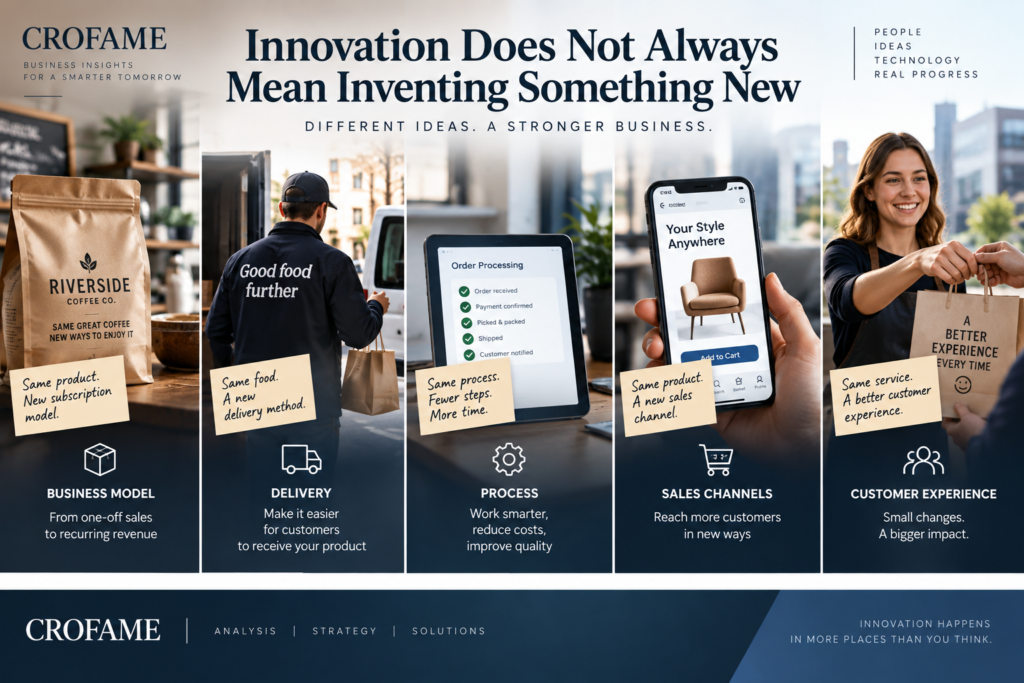
Innovation is often associated with breakthrough inventions, new technologies or completely new products. In practice, a business can innovate without inventing anything from scratch. It may change how a product is sold, how customers receive a service, how employees complete a process or how the company generates revenue. The OECD defines business innovation broadly as a new or significantly improved product or business process that has actually been introduced into the market or put into use by the firm. (DOI)
This distinction matters because many businesses already have a product customers want. Their opportunity may not be to invent another product, but to make the existing business easier to buy from, cheaper to operate or more valuable to customers.
The Product Can Stay the Same While the Business Model Changes
Imagine a company that sells equipment for £1,000 as a one-off purchase. Instead of designing completely new equipment, it introduces a maintenance subscription for £40 per month. The physical product remains largely unchanged, but the company has created recurring revenue and an ongoing customer relationship.
Example: 500 customers × £40 monthly subscription = £20,000 recurring monthly revenue. The innovation is not necessarily the product itself; it is the way value is packaged and delivered to the customer.
This type of change can affect sales, customer service, pricing and internal processes simultaneously. OECD guidance recognises that innovation can involve several business functions and that new processes can be introduced to improve distribution, marketing, sales, administration or other parts of the organisation. (OECD)
Innovation Can Be a Better Delivery Method
A restaurant does not need to invent a new type of food to innovate. It might introduce pre-ordering, collection lockers, subscription lunches or a more efficient delivery model. A retailer can sell the same products but add click-and-collect. A professional-services company can replace repeated face-to-face administration with a secure online client portal.
The underlying product may remain familiar, but the customer experience changes. If the new method is significantly different from the company’s previous process and is actually put into use, it can represent business process innovation under the OECD framework. (OECD)
A Process Improvement Can Be Innovation
Innovation can also happen where customers barely notice it. A manufacturer may redesign its production line so products move through fewer stages. A warehouse can introduce a different picking system. A service company may connect its CRM and invoicing software so employees no longer enter the same information twice.
Example: A process previously requires eight steps and 30 minutes per order. After redesign, it requires five steps and 18 minutes. Across 1,000 orders, that saves 200 working hours.
Nothing new has necessarily been invented for the wider market. The company has simply developed a significantly better way of operating.
The OECD explicitly includes business process improvements aimed at reducing costs, improving quality, working conditions, reliability or efficiency within its concept of innovation. (OECD)
Innovation Can Come From Removing Something
Businesses often think innovation means adding more features, more services or more technology. Sometimes the stronger innovation is simplification.
A customer application containing fifteen steps may be redesigned to contain five. A product range of 200 poorly performing variations may be reduced to 50 clearer options. A company may remove three approvals from an internal workflow because they do not materially reduce risk.
The result may be lower cost, faster service and a better customer experience even though the company has technically introduced less, not more.
Innovation should therefore be judged by the improvement it creates, not by how complicated the idea appears.
A New Sales Channel Can Change the Business
A business that has always sold through physical locations may create an online channel. A manufacturer selling only through distributors may begin selling directly to selected customers. A service company may introduce self-service purchasing for simpler products while retaining personal sales for complex contracts.
The product itself can remain almost unchanged, but the route to the customer is different. OECD innovation guidance includes marketing, sales and distribution within the business functions where process innovation can occur. (OECD)
Example: A company previously needs a salesperson to process every £50 order. After introducing online self-service for standard products, sales staff concentrate on higher-value customers while routine orders can be completed automatically.
The innovation creates value by changing how the company sells, not necessarily what it sells.
Existing Technology Can Create Innovation When Used Differently
A company does not need to develop its own technology for a change to count as innovation. The OECD specifically notes that innovation can include improvements that were not primarily developed by the firm itself. What matters is that the new or improved product or process is significantly different for that business and has been implemented. (OECD)
A small company may therefore innovate by adopting technology that has existed for years. Introducing online booking, digital inventory tracking or automated payment reminders may not be technologically revolutionary, but it can still fundamentally improve that company’s operations.
This is particularly important for SMEs because innovation does not require a research laboratory or a large R&D department.
Innovation Does Not Have to Be Radical
There is also a difference between radical innovation and continuous improvement. Some businesses introduce major changes that create entirely new markets. Others innovate through smaller but meaningful improvements accumulated over time.
The OECD notes that firms organise innovation in different ways. Some use formal innovation programmes and budgets, while others integrate innovation into normal operations through continuous improvements to products and processes. Both approaches fall within the broader innovation framework. (OECD)
For a small business, several well-chosen improvements may therefore create more value than one ambitious project that is expensive and difficult to implement.
Innovation Still Has to Be Implemented
An idea alone is not innovation. A company can discuss a new subscription service, design a new process or develop a prototype, but the OECD definition distinguishes innovation from invention partly through implementation. The product must be introduced to users or the new business process must actually be put into use. (DOI)
That is an important business lesson. Organisations can spend months discussing innovation without changing anything. The value appears when an idea is tested, implemented and produces a measurable improvement.
A simple process change that saves hundreds of hours each year may therefore be more valuable than a sophisticated concept that never leaves the presentation stage.
Innovation Is Already Broader Than New Products
The latest UK Innovation Survey reinforces this broader view. During 2022–2024, 34% of UK businesses were classified as innovation-active, and the official definition included both new or improved products and business processes, as well as ongoing innovation projects. (GOV.UK)
That means innovation can appear in production, logistics, marketing, customer service, management, technology and other business functions. It can involve a new product, but it does not have to.
For managers, the better question is therefore not simply “What can we invent?” It is “What could we do significantly better than we do today?”
A new delivery method, recurring-revenue model, simpler process, digital sales channel or improved customer experience can all create competitive advantage without requiring the business to invent the next revolutionary technology.
Innovation is ultimately about creating or preserving value through meaningful change. Sometimes that means inventing something entirely new. Sometimes it means looking at something the business already does and finding a much better way to do it.
Category: Growth & Innovation
Secondary category: Business Theory
Sources
OECD/Eurostat — Oslo Manual 2018: Guidelines for Collecting, Reporting and Using Data on Innovation. Defines business innovation as a new or significantly improved product or business process that has been introduced or put into use, and distinguishes implementation from invention. (DOI)
OECD — Concepts and Definitions for Measuring Business Innovation. Covers product innovation, business process innovation, continuous improvement and innovation across functions including production, distribution, marketing, sales and administration. (OECD)
UK Department for Business and Trade — UK Innovation Survey 2025, published June 2026. Reports that 34% of UK businesses were innovation-active during 2022–2024 and uses the OECD framework covering both product and business process innovation. (GOV.UK)