
Rapid growth is usually treated as a success. More customers, higher sales and larger contracts can all suggest that a business is moving in the right direction. But growth can also expose weaknesses that were manageable when the company was smaller. If sales increase faster than staffing, systems, cash flow or operational capacity, the business may become less reliable at exactly the moment demand is strongest.
The OECD notes that scaling is not simply a period of higher sales. Growing firms often need to change their management structure, financing model and internal organisation as they become larger, and some businesses struggle to adapt after rapid expansion. (OECD)
Sales Can Grow Faster Than Capacity
A company may be able to attract new customers much faster than it can recruit and train employees or increase production. At first, this can look positive because revenue rises sharply, but the pressure eventually appears elsewhere in the business through longer waiting times, unfinished work and declining service quality.
Example: Sales increase by 50%, but staff capacity increases by only 10%. The business receives far more orders, while almost the same number of employees must process them. Delivery times increase, customer-service queues become longer and mistakes become more frequent.
The problem is not that the company has too many customers. The problem is that demand has grown faster than the operating system supporting it.
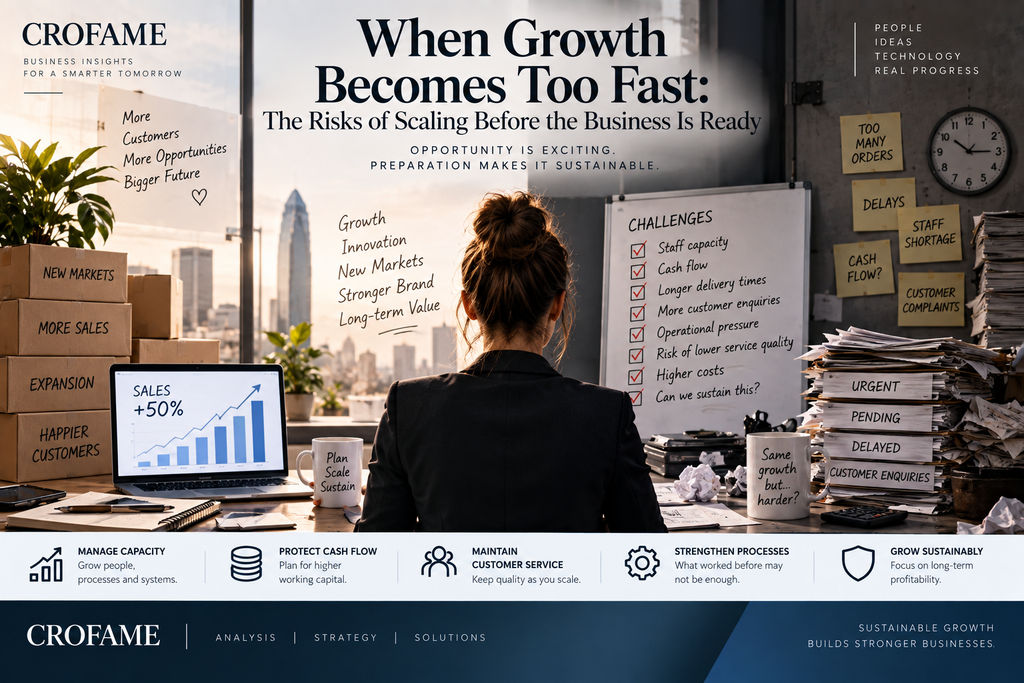
Growth Can Create a Cash-Flow Problem
One of the most surprising risks is that a profitable business can run short of cash while growing. New sales often need to be financed before the business actually receives payment. Companies may have to purchase stock, hire employees, pay suppliers or increase production capacity weeks or months before customers pay their invoices.
The UK Insolvency Service specifically warns that businesses are particularly exposed to cash-flow difficulties during growth, while the British Business Bank notes that growth can create cash pressure because each additional sale may require working capital, inventory and credit before payment arrives. (GOV.UK)
Example: A business receives a large order worth £100,000, but must spend £60,000 on stock and labour before delivery. The customer pays 60 days later. The order may be profitable, but the business still needs £60,000 of cash available first.
Growth therefore increases revenue potential while also increasing the amount of money required to keep operations moving.
Customer Service Can Deteriorate
A small team may provide excellent service when it manages 200 customers. If the customer base suddenly grows to 800 while the service team remains almost the same size, response times are likely to change.
Customers do not normally care that the business is experiencing rapid growth. They see unanswered emails, delayed orders or difficulty contacting someone when something goes wrong. A company can therefore damage the reputation that originally helped it grow.
This is why growth should be measured alongside operational indicators such as response times, complaints, delivery performance and customer retention. Higher sales are less valuable if the company begins losing existing customers because service standards have fallen.
Processes That Worked at a Small Scale May Stop Working
Rapid growth also exposes weak processes. When a company has five employees, informal communication can be enough. People know what colleagues are doing, decisions can be made quickly and the owner may personally approve most important actions.
That becomes much harder with 50 or 500 employees. Responsibilities need to become clearer, information must be stored consistently and processes need to work without depending on one person remembering everything.
A spreadsheet containing customer orders might work perfectly at 100 orders per month but become unreliable at 5,000. An approval process that requires the founder’s signature may work at a small scale but eventually turn the founder into a bottleneck.
Scaling therefore often requires changing the way the business operates rather than simply doing more of what it already does.
Hiring Quickly Can Create New Problems
More demand often requires more employees, but rapid recruitment can create its own risks. Hiring too quickly may result in weak onboarding, inconsistent standards or employees being placed into roles before responsibilities are properly defined.
Management capacity can also become stretched. A founder who successfully managed ten employees may suddenly be responsible for forty people, several managers and multiple departments. The skills required to start a company are not always the same skills required to manage a larger organisation.
OECD research on scaling firms highlights managerial capability, skills and organisational change as important parts of maintaining growth once a business becomes larger. (OECD)
Growth Can Increase Financial Risk
Expanding businesses often require investment in inventory, equipment, premises, technology or employees. That may involve using retained profits, external investment or additional debt.
OECD research found that scaling SMEs tend to increase both assets and debt as they expand and may face higher borrowing costs as their financial risk grows. The same research found that not every company sustains its new scale: some later contract and some cease operating. (OECD)
This does not mean borrowing to grow is a poor strategy. It means management must understand what happens if demand develops more slowly than expected. A warehouse lease, machinery loan or expanded payroll remains a cost even if sales forecasts are missed.
A Big Contract Can Be Both an Opportunity and a Risk
Rapid growth is sometimes triggered by one major customer.
Imagine a small manufacturer wins a contract that doubles annual revenue. To deliver it, the company hires staff, purchases equipment and rents additional warehouse space. If the contract continues for several years, the expansion may transform the business. If the customer cancels after one year, the company is left with a much larger cost base.
The original decision may still have been reasonable. Business growth always involves uncertainty. The important question is whether the company has considered what happens if the expected growth does not continue.
Scenario planning can therefore include questions such as: What if demand is 20% below forecast? How long could the company support the larger payroll? Could equipment be used for other customers? How dependent will revenue become on one contract?
Growth Should Protect Profitability, Not Just Revenue
Government guidance on business growth specifically advises companies to consider profitability rather than focusing only on increased sales. (GOV.UK)
This distinction becomes increasingly important during rapid expansion. A company can double revenue while margins decline because it hires too quickly, pays premium prices for urgent supplies or spends heavily correcting operational problems.
For example, revenue may rise from £1 million to £1.5 million, but if costs increase from £800,000 to £1.35 million, profit falls from £200,000 to £150,000. The company has grown by 50% in revenue but become less profitable.
Growth should therefore be analysed through margins, cash flow and operational performance rather than revenue alone.
The Business Needs to Scale Before the Problems Do
Good scaling does not mean avoiding growth. It means ensuring that the capabilities supporting growth develop alongside demand.
That may require stronger financial forecasting, more working capital, improved systems, additional management capacity, clearer processes and better recruitment before the next phase of expansion begins. Sometimes the correct decision is to accept every new opportunity. At other times, deliberately slowing growth can protect the long-term business.
The British Business Bank notes that expanding production, opening new locations and growing product lines typically require additional capital, while adequate working capital helps businesses maintain day-to-day operations during that expansion. (British Business Bank)
Fast Growth Is Only Valuable If the Business Can Sustain It
Rapid growth can create enormous opportunities, but it also increases pressure on almost every part of a company. Staff capacity, customer service, processes, cash flow, management and financing all need to evolve as demand increases.
The objective is therefore not simply to grow as fast as possible. It is to build an organisation capable of supporting the growth it achieves.
A useful management question is not only “How much more can we sell?” but “If sales rise by another 50%, can the rest of the business actually handle it?”
If the answer is no, the next investment may need to be in capacity rather than customer acquisition.
Category: Growth & Innovation
Secondary category: Business Strategy
Sources
OECD — Unleashing SME Potential to Scale Up (2025). Examines the organisational, financial and managerial changes firms experience during and after rapid growth. (OECD)
OECD — Which Start-ups Achieve Scale? (2026). Discusses finance, managerial capabilities, innovation and market expansion among firms that successfully scale. (OECD)
UK Insolvency Service — Director Information Hub: Cashflow. Explains why cash-flow pressure can be particularly significant during business growth. (GOV.UK)
British Business Bank — What Is Cash Flow and How Do You Manage It? and Protecting Cash Flow and Working Capital. Covers the working-capital requirements created by expanding sales, stock and customer credit. (British Business Bank)
GOV.UK — Growing Your Business: Plan for Growth. Advises businesses to consider profitability as well as increased sales when planning expansion. (GOV.UK)