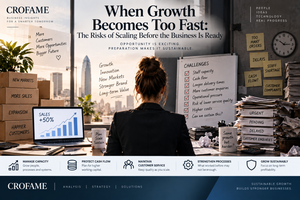

Some businesses grow quickly while others remain almost the same size for years. The difference is not always the quality of the original idea. Growth usually depends on a combination of demand, management capability, access to finance, productivity, innovation and the ability to turn opportunities into repeatable business activity.
OECD research on scaling firms shows that high-growth businesses are often already more productive than similar firms before their rapid growth phase begins. They also tend to invest in areas such as physical capital, workforce skills and innovation as they scale. (OECD)
Growth Usually Starts Before the Numbers Show It
Rapid growth can appear sudden from the outside, but businesses often prepare for it earlier. They may improve processes, hire specialist staff, build supplier relationships, invest in equipment or develop new products before revenue begins to rise significantly.
OECD analysis of scaling SMEs found that growth is often connected with strategic preparation and organisational transformation in the years before the high-growth period. (OECD)
Example: Two companies each sell £500,000 a year. Company A uses most of its profit for short-term spending. Company B invests in a better production system, staff training and additional sales capacity. A year later, demand increases. Company B can accept more orders immediately, while Company A cannot increase output fast enough.
The market opportunity is the same, but the businesses are not equally prepared to use it.
Some Businesses Find a More Scalable Model
A business can grow faster when additional sales do not require costs to rise at exactly the same rate. A consultancy may need another employee for every group of new clients, while a software company can sometimes add thousands of users without increasing its workforce proportionally.
This does not mean digital businesses automatically succeed. It means certain business models make expansion easier because part of the existing infrastructure can support additional customers.
The same principle can apply outside technology. A manufacturer may increase output using the same machinery more efficiently, while a retailer can expand through e-commerce without immediately opening another physical shop.
Innovation Can Create New Sources of Growth
Growth also comes from finding new ways to generate value. That may mean introducing a new product, improving an existing service, entering another market or changing the business model.
UK Innovation Survey data shows that 34% of UK businesses were innovation-active during 2022–2024, with larger businesses more likely to report innovation activity than SMEs. (GOV.UK) McKinsey’s 2025 survey of more than 1,000 companies also found that respondents most frequently identified innovation capability as the most important strategic factor for growth over the following year. (McKinsey & Company)
Example: A company sells equipment as a one-off purchase. It later introduces maintenance subscriptions and training. The physical product has not changed significantly, but the company has created recurring revenue from the same customer base.
Growth therefore does not always require finding a completely new customer. Sometimes it comes from creating more value from an existing relationship.
Management Capability Becomes More Important as the Business Grows
The skills required to start a company are not always the same skills needed to scale it. A founder may be excellent at sales or product development but eventually need stronger financial control, operations management, recruitment or delegation.
OECD productivity research identifies workforce skills and management skills among the factors associated with differences in productivity between firms. (OECD)
A business can therefore have strong demand and still struggle to grow because management becomes a bottleneck. If every decision must be approved by one founder, expansion eventually slows because the organisation cannot make decisions quickly enough.
Access to Finance Can Determine How Fast an Opportunity Is Used
Growth itself can require money. A company receiving a large new contract may need to purchase stock, hire employees or increase production before the customer pays.
A profitable opportunity can therefore be difficult to exploit if the company cannot finance the period between investment and revenue.
This is one reason companies with access to suitable finance can sometimes grow faster than competitors with similar products. OECD research on scale-ups identifies finance as one of several interrelated constraints businesses may need to overcome as they expand. (OECD)
Customer Retention Can Make Growth Easier
Growth is harder when a business constantly needs to replace customers who leave. A company that retains customers begins each period with an existing revenue base and can add new customers on top of it.
Example: Company A gains 100 customers but loses 80 existing customers. Net growth = 20 customers. Company B gains the same 100 customers but loses only 20. Net growth = 80 customers.
Both companies have identical customer acquisition, but one grows four times faster because it retains more of what it already has.
That is why customer experience, reliability and product quality can be growth strategies even though they do not look like traditional sales activities.
Growth Also Depends on the Market
Not every difference in growth comes from management. Some businesses operate in markets where demand is expanding rapidly, while others operate in mature or declining sectors.
A capable company in a slow-growing market may expand more gradually than an average company benefiting from a rapidly expanding market. Timing therefore matters.
But market growth alone does not guarantee success. Businesses still need enough capacity, finance and organisational capability to capture the opportunity.
Productivity Allows Growth Without Proportional Cost Growth
Productivity is another major difference between firms. ONS data shows substantial variation in labour productivity between UK businesses: in 2023, workers in firms at the 90th percentile of productivity produced around 3.5 times more output than workers in the median firm. (Office for National Statistics)
That matters because a more productive company can generate more output from the same amount of labour or capital. It may therefore have more capacity to invest, compete on price or absorb periods of weaker demand.
Growth that comes only from continuously adding employees can become expensive. Growth supported by improving productivity is more likely to strengthen the economics of the business.
Fast Growth Is Usually a Combination, Not One Secret
There is rarely one reason a company grows faster than another. A strong product without demand will struggle. Demand without operational capacity can create delays. Finance without good management can be wasted. Innovation without commercialisation may never generate meaningful revenue.
The strongest growth usually comes when several elements work together: market demand, a scalable operating model, capable management, finance, productivity, customer retention and innovation.
This is why growth should not simply be measured by how quickly sales increase. Businesses should also ask whether the organisation is becoming strong enough to support the new scale.
A company that prepares before the opportunity appears is much more likely to benefit when it does.
Category: Growth & Innovation
Sources
OECD — Unleashing SME Potential to Scale Up (2025). Examines productivity, investment, skills and innovation among scaling firms. (OECD)
OECD — Understanding Firm Growth. Finds that scaling often reflects strategic preparation and transformation before the high-growth phase. (OECD)
OECD — Which Start-ups Achieve Scale? (2026). Examines innovation, finance, managerial capability and market expansion among scaling start-ups in the EU and US. (OECD)
UK Department for Business and Trade — UK Innovation Survey 2025. Reports innovation activity among UK businesses during 2022–2024. (GOV.UK)
Office for National Statistics — Trends in UK Business Dynamism and Productivity 2025. Provides firm-level evidence on productivity differences across UK businesses. (Office for National Statistics)
McKinsey & Company — How Top Performers Use Innovation to Grow Within and Beyond the Core (2025). (McKinsey & Company)