Why Inefficient Processes Cost More Than Businesses Realise
Most inefficient processes do not look dramatic. There is rarely one obvious mistake costing the company thousands of pounds at once. Instead, the cost appears in small activities repeated every day: entering the same information twice, waiting for approval, searching for documents, correcting errors, chasing colleagues for updates or creating reports manually because systems do not communicate with each other.
Individually, these tasks can seem insignificant. Across a team, department or entire organisation, however, they consume time, delay customers and increase operating costs. Asana’s research into knowledge work found that employees estimated better processes could save them around 4.9 hours per week, illustrating how routine coordination and administrative friction can accumulate into a substantial productivity cost. (Asana, Inc.)
The problem is that many businesses measure obvious expenses such as salaries, software and materials, but do not measure the cost of the way work moves through the organisation.

Example 1: Entering the Same Customer Information Three Times
Imagine a small service company receives an enquiry through its website. An employee copies the customer’s details into a spreadsheet. When the customer agrees to proceed, another employee enters the same information into the invoicing system. Later, the operations team enters it again into its project-management platform.
Nothing appears seriously wrong. Each entry might take only a few minutes.
But suppose the company processes 400 new customers every month and each customer requires ten unnecessary minutes of duplicate data entry. That creates around 67 hours of additional work every month before considering corrections, checking or mistakes.
The larger cost may come from errors. A telephone number is copied incorrectly, an address differs between systems or someone updates the CRM but forgets to update the spreadsheet. Employees then spend more time identifying which version is correct.
This is an example of an inefficient process creating both a labour cost and a data-quality problem.
The better question is not, “How can employees enter the information faster?” It is, “Why is the information being entered more than once?”
Example 2: The £500 Purchase That Requires Five Approvals
Approval processes are another common source of hidden cost.
Consider a company where every purchase above £500 requires approval from a team manager, department head, finance manager, finance director and senior executive. The purpose is understandable: the company wants control over spending.
But now imagine an employee needs a replacement monitor. The request may sit in one manager’s inbox for two days, move to finance for another day, return because one field was incomplete and then wait for the final approval.
Nobody spends hours actively working on the request, but the elapsed time may be a week.
The business therefore experiences two types of cost. Employees spend time checking the request, sending reminders and approving something several other people have already approved. At the same time, the employee waiting for the equipment may be unable to work normally.
A control designed to reduce financial risk can therefore become disproportionately expensive if it is applied to every purchase regardless of value or risk.
Process optimisation does not necessarily mean removing controls. It may mean creating different approval routes for £500, £5,000 and £500,000 purchases.
Example 3: The Weekly Report That Takes Half a Day
Many organisations have reports that were created years ago and continue to be produced because “management has always received them.”
Imagine a team leader spends every Friday morning downloading figures from three systems, copying them into Excel, correcting formatting and creating a presentation showing weekly performance.
The report takes four hours.
That equals roughly 200 working hours per year for one report.
Now imagine five departments doing something similar.
The organisation could be spending around 1,000 hours annually creating reports rather than analysing what those reports actually mean.
This distinction matters. Producing information and analysing information are not the same activity.
Microsoft’s Work Trend Index found that employees using Microsoft 365 spent a significant proportion of their working time on communication and coordination, while 62% of survey respondents reported struggling with excessive time spent searching for information. (Microsoft)
A well-designed reporting process should therefore ask whether the information can be generated automatically and whether every report is still used to make a decision.
If nobody makes a decision from it, the business should question why it exists.
Example 4: A Customer Waits While Departments Wait for Each Other
Process inefficiency also affects customers.
Consider an insurance, property or professional-services company where a customer request moves through four departments. Customer service receives the request and sends it to operations. Operations needs confirmation from finance. Finance requests additional information from the customer. The customer sends it back to customer service, which forwards it again to operations.
Each department may complete its own task efficiently.
Yet the overall customer journey is slow.
This is an important process problem because organisations often optimise individual departments instead of the complete workflow.
McKinsey has warned that organisations can create new inefficiencies when they improve or automate individual steps without considering the handoffs between upstream and downstream parts of a process. (McKinsey & Company)
A process can therefore contain several efficient teams and still produce an inefficient result.
The customer does not care that Finance answered within its internal two-hour target. The customer cares that the entire request took nine days.
Example 5: Fixing the Same Error Every Week
Rework is another hidden cost.
Suppose invoices regularly reach finance without a purchase-order number. Finance emails the relevant employee. The employee searches for the purchase order and replies. Finance updates the invoice and continues processing it.
Everyone may become so familiar with the routine that it stops looking like a problem.
But the business is repeatedly paying employees to correct the same preventable error.
Process optimisation looks for the point where the error begins rather than simply improving the correction process.
Perhaps the purchase-order number should be mandatory when the invoice is submitted. Perhaps the system can match the invoice automatically. Perhaps suppliers need clearer instructions.
The objective is to prevent rework rather than become faster at performing it.

Example 6: Automation Makes the Bad Process Faster
Technology does not automatically solve inefficient processes.
Imagine a business has a ten-stage customer onboarding process containing three unnecessary approvals and duplicated data entry. Management introduces automation so documents move between departments more quickly.
The company now has a faster ten-stage inefficient process.
McKinsey specifically cautions that automating inefficient or obsolete processes can prevent organisations from capturing the expected savings. It recommends redesigning the process before deciding which parts should be automated. (McKinsey & Company)
This is why process optimisation should usually come before automation.
The sequence should be:
Understand the process → remove unnecessary work → simplify the workflow → then automate where it adds value.
Otherwise, technology can make waste more sophisticated without eliminating it.
Waiting Is a Cost Even When Nobody Is Working
One of the most overlooked process costs is waiting.
A contract waits for review. An employee waits for access to a system. A customer waits for approval. A project waits because one person has not supplied information.
During that period nobody may be actively charging time to the task, so the delay appears inexpensive.
But waiting has consequences.
The customer may go elsewhere. The project finishes later. Revenue is delayed. Employees cannot progress to the next activity. Managers spend time chasing updates.
This is why process performance should not be measured only by how long individual tasks take. Businesses should also measure the total time between the beginning and end of the process.
A task might require only 30 minutes of actual work but take five days to complete because it spends most of its life waiting.
The Hidden Cost of Searching
Another common form of process waste is searching for information.
“Where is the latest version?”
“Who approved this?”
“Did Finance reply?”
“Which spreadsheet contains the correct figures?”
“Who is responsible for this customer?”
These questions are so normal in some businesses that they are treated as part of working life.
But they represent process cost.
Microsoft’s research found that 62% of surveyed workers struggled with spending too much time searching for information, while 68% said they lacked sufficient uninterrupted focus time during the working day. (Microsoft)
The underlying problem may be unclear ownership, inconsistent storage, too many communication channels or badly integrated systems.
Adding another platform may not solve it.
Sometimes the improvement is simply agreeing where information belongs and who is responsible for maintaining it.
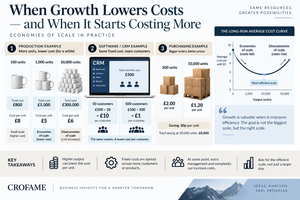
Inefficiency Multiplies as a Business Grows
A poor process may be manageable when a company has ten employees and twenty customers.
It becomes much more expensive when the organisation grows.
If one unnecessary task takes five minutes and happens ten times a week, it creates less than an hour of waste. If the same task eventually happens 2,000 times every week, the business is spending more than 160 hours performing work that creates no additional value.
This is why growth often exposes process problems that were already present.
The problem did not suddenly appear.
The volume made it visible.
Businesses preparing for growth should therefore ask whether their processes can scale, not simply whether their sales can.
How to Identify an Inefficient Process
A useful starting point is to follow one real transaction from beginning to end: one customer order, one invoice, one complaint or one employee onboarding.
Observe what actually happens rather than relying only on the official procedure.
Where is information entered twice? Where does work wait? Which approvals genuinely influence the decision? Where do employees leave the official system and create their own spreadsheet? Which mistakes repeatedly require correction? Where does somebody have to chase another person before work can continue?
These small points of friction often reveal more than a high-level process diagram.
Employees performing the work are particularly valuable here. They usually know which parts of the process cause difficulty because they deal with those problems every day.
Improving a Process Does Not Always Require New Technology
Process optimisation is sometimes associated with expensive software projects, but many improvements are organisational rather than technological.
A company may eliminate an unnecessary approval, combine two forms, define one source of customer data, assign clear responsibility for a task or stop producing a report nobody uses.
Those changes may cost almost nothing.
Technology becomes useful when it addresses a real constraint: automatically transferring information, generating reports, checking data, routing requests or removing genuinely repetitive manual activity.
The objective is not to create the most automated process.
The objective is to create the simplest reliable process that produces the required outcome.
Small Inefficiencies Become Large Business Costs
The reason inefficient processes are dangerous is that the cost rarely appears under a single heading in the accounts.
It appears as overtime, delayed revenue, additional employees, customer complaints, mistakes, slower projects, unnecessary meetings, duplicated work and management time.
A company may therefore believe it has a staffing problem when it actually has a process problem.
It may hire another administrator because the team cannot manage the workload when the deeper issue is that existing employees are spending hours copying information between systems.
It may purchase new software because reports take too long when the real problem is that the company produces twenty reports but actively uses only five.
That is why process optimisation begins with understanding work before attempting to add resources.
Before asking “Do we need more people or better technology?”, businesses should ask:
“How much of the work we are currently doing actually needs to be done?”
Removing unnecessary work can be one of the cheapest forms of business improvement.
Category: Process Optimisation
Sources
McKinsey & Company — Winning in Automation Requires a Focus on Humans. McKinsey discusses how poor handoffs and automating individual steps without considering the end-to-end process can limit the value of automation. (McKinsey & Company)
McKinsey & Company — How to Avoid the Three Common Execution Pitfalls That Derail Automation Programs. The article highlights the risk of automating inefficient or obsolete processes before redesigning them. (McKinsey & Company)
Asana — Anatomy of Work Global Index 2023. Survey of more than 9,600 knowledge workers across six countries, including findings on time spent coordinating work and potential time savings from improved processes. (Asana, Inc.)
Microsoft — 2023 Work Trend Index: Will AI Fix Work? Based on a survey of 31,000 workers across 31 markets and Microsoft 365 activity data, including findings on searching for information, communication and focus time. (Microsoft)