
Why Digital Transformation Fails Even When the Technology Works
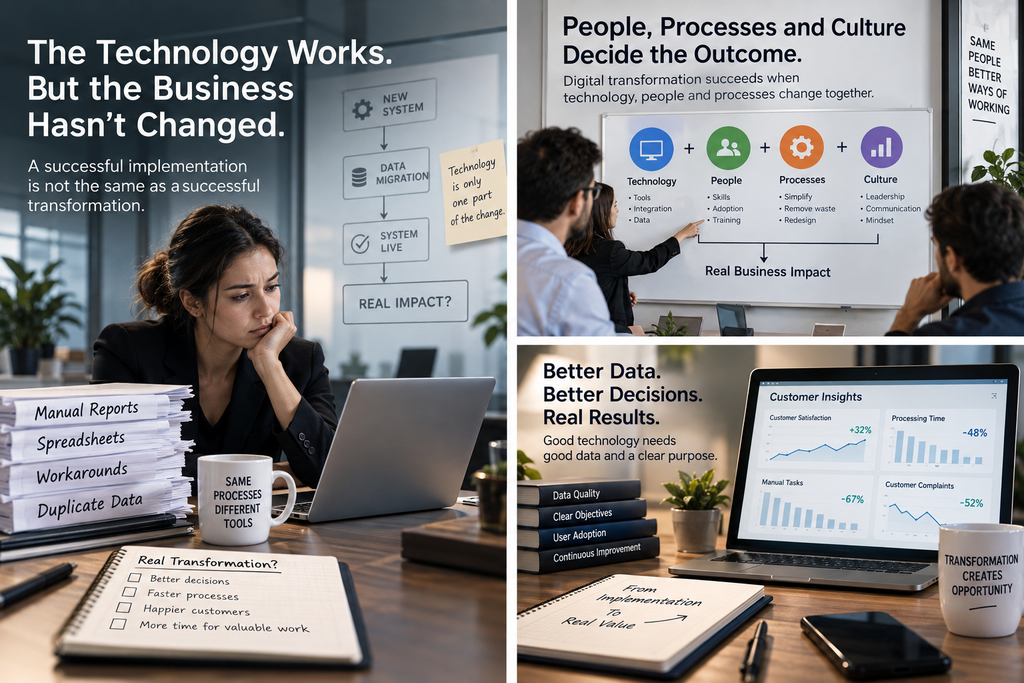
A company can buy excellent software, migrate its data successfully, connect all the required systems and still fail to achieve digital transformation. The technology may work exactly as promised, yet employees continue using spreadsheets, customers experience the same delays, managers still request manual reports and productivity barely changes.
This happens because digital transformation is not the same as technology implementation. Installing a new CRM, ERP platform, automation tool or AI system changes the technology available to an organisation. Transformation happens only when the way the organisation works changes as well.
McKinsey describes successful digital transformation as requiring coordinated changes across technology, data, processes, talent and organisational behaviour. Its research also emphasises that adoption and change management need to be planned from the beginning rather than added after a system has already been built. (McKinsey & Company)
A Successful Installation Can Still Be a Failed Transformation
Imagine a company replacing several spreadsheets with a new customer relationship management system. The migration works. Customer records are available. Dashboards generate reports and the platform is technically reliable.
Six months later, however, the sales team is still keeping a separate spreadsheet because it feels faster. Customer service records information differently. Managers export data into Excel before analysing it. Employees enter information into the CRM mainly because management requires it.
The system works, but the business has not really changed.
This is the crucial distinction. Technology implementation asks: “Does the system work?” Digital transformation asks: “Does the business work better because of the system?”
A project can therefore meet its technical requirements while failing commercially or operationally.
Old Processes Often Survive Inside New Systems
One of the most common mistakes is digitalising a process without first examining whether the process itself makes sense.
Over time, organisations accumulate procedures. Another approval is added after a problem. Another spreadsheet is introduced because one department needs additional information. Another report is created for management. Employees become accustomed to these steps and eventually they are treated as necessary simply because they have always existed.
When a new platform is introduced, the company may reproduce the entire old workflow inside the new technology. Instead of eliminating unnecessary steps, it creates digital versions of them.
The result is not transformation. It is the same inefficient process delivered through a more modern interface.
Recent McKinsey research on digital operations stresses the importance of human-centred process redesign and involving frontline workers in the development of solutions rather than simply imposing new technology on existing work. (McKinsey & Company)
Before automating a process, businesses should therefore ask a more fundamental question: Should this process exist in its current form at all?
Employees Create Workarounds When Technology Does Not Match Reality
Workarounds are often treated as employee resistance, but they can also be useful evidence.
If employees repeatedly copy information into personal spreadsheets, create unofficial templates or avoid certain parts of a new platform, management should investigate why. The problem may not be that employees dislike change. The official system may genuinely make their work more difficult.
For example, management may design a process consisting of seven steps because it looks logical on a process map. Employees dealing with customers may know that real situations rarely follow those seven steps in the same order.
If the system cannot handle exceptions, employees will create another way of working.
Soon the company has two processes: the official digital process and the real process employees actually use.

The UK government’s 2025 research into technology adoption found that business decisions about new technology are shaped by several interconnected factors rather than one single issue. Businesses identified factors including clarity of the use case, affordability, capability and organisational willingness to change. (GOV.UK)
This is why users need to be involved before, during and after implementation.
Training Is More Than Showing People Where to Click
A common transformation plan looks like this: select the system, configure it, migrate the data, provide a training session and launch.
The training session may demonstrate where buttons are located and how basic tasks are performed. But knowing how software functions is not the same as understanding how work should now be done.
Employees also need to know why the process changed, which old activities should stop, what information they are responsible for, what happens when something goes wrong and where decisions now sit.
Deloitte argues that sustained digital adoption requires ongoing learning, communication, user guidance and analysis of how people actually use a system. Training delivered once at launch is unlikely to be enough when systems and working practices continue to evolve. (Deloitte)
This is particularly important for employees who use a platform only occasionally. Someone working in a system every day will quickly develop familiarity. Someone completing the same process once every two months may need support each time.
Digital transformation therefore requires capability building, not simply system training.
Poor Data Can Make Good Technology Look Bad
Technology is also only as useful as the information flowing through it.
A company may invest in an advanced analytics platform and produce impressive dashboards. But if customer records are duplicated, product categories are inconsistent, employees leave fields blank and departments define metrics differently, the dashboard can present inaccurate information beautifully.
The technical system is functioning. The business problem is data quality.
McKinsey identifies reliable, accessible and current data as a core element of digital transformation and stresses the need for appropriate data architecture and governance. (McKinsey & Company)
This becomes even more important when companies introduce AI. Traditional software may display incorrect information. AI can use incorrect information to generate recommendations, predictions or automated actions.
Better technology therefore increases the importance of understanding where data comes from, who owns it and how its quality is maintained.
The Project Ends, but Transformation Should Not
Another common problem begins immediately after launch.
During implementation, the project receives considerable attention. There are meetings, deadlines, consultants, project managers and escalation procedures. Everyone knows who is responsible for fixing problems.
Then the system goes live.
The consultants leave. The project team moves onto something else. Employees begin discovering smaller issues that were impossible to anticipate during testing.
Nobody clearly owns them.
Requests accumulate. Temporary workarounds become permanent. Different departments begin adapting the system in different ways. A year later, management complains that the platform never delivered what was expected.
Digital transformation needs ownership after implementation. Someone needs responsibility for adoption, performance, process improvement, user feedback, data quality and future changes.
McKinsey has argued that responsibility for adoption ultimately needs to sit with the business rather than being treated solely as the responsibility of a digital or technology team. (McKinsey & Company)
Technology can be supplied by IT. Business change cannot be outsourced entirely to IT.
Measuring Delivery Is Not the Same as Measuring Value
Digital projects are often measured using traditional project metrics. Was the system launched on time? Was it delivered within budget? Were all planned features completed?
Those questions matter, but they do not establish whether the transformation succeeded.
If a new platform was introduced to reduce processing time, the business should know how long the process took before implementation and how long it takes afterwards. If automation was intended to reduce manual administration, the organisation should measure how many employee hours have actually been saved. If the goal was improved customer service, waiting times, complaints or customer satisfaction should change.
Without a baseline, almost any project can be described as successful.
The supplier may say the implementation succeeded because the software works. The project team may say it succeeded because it launched on time. Employees may say it failed because the new process takes longer.
All three can be describing the same project.
Digital transformation needs business outcomes, not only technical milestones.
Technology Cannot Fix an Unclear Business Problem
Another reason transformations fail is that companies sometimes decide to purchase technology before clearly defining the problem.
Management may decide that the organisation needs AI, a new CRM, automation or a new reporting platform because competitors are using similar technologies or because an existing system feels outdated.
The conversation then becomes focused on vendors and features.
But the organisation has not established what should improve.
The UK Technology Adoption Review published in 2025 found that financial constraints, skills, organisational issues and the suitability of technology all influence business adoption. More recent OECD analysis of UK SMEs similarly identifies cost, relevance, managerial capability, workforce skills and resistance to change as important barriers. (GOV.UK)
A useful starting question is therefore not “Which system should we buy?”
It is “What business problem are we trying to solve, and how will we know when it has improved?”
The technology decision comes afterwards.
More Technology Can Create More Complexity
Digital transformation can also fail because organisations continuously add systems without removing anything.
A company introduces a CRM for sales, another platform for project management, a separate HR system, communication tools, analytics software, document storage, automation tools and several AI applications.
Each system may be useful individually.
Together, they may create a fragmented environment in which employees constantly switch applications, copy data between platforms and search several places for the same information.
The company has become more digital, but not necessarily more efficient.
The OECD notes that digital transformation involves combining different technologies and organisational assets and that firms may face challenges including interoperability, skills gaps and limited internal resources. (OECD)
This is why digital strategy should include decisions about what to remove, not only what to introduce.
Sometimes transformation means adding technology. Sometimes it means consolidating three systems into one.
Small Businesses Have Less Room for Failed Transformation
These issues are particularly important for SMEs.
A large company may be able to absorb the cost of an underused technology platform. A small business has less capacity to waste money, management time and employee attention on systems that do not create value.
The OECD’s 2025 survey of SMEs across ten countries found that only around half reached a “competent” or higher level on its digital maturity measure. Maintenance costs were reported as a barrier by 40% of surveyed SMEs, while 39% identified lack of time for training and 32% hardware costs. (OECD)
The OECD’s 2026 review of SME technology adoption in the UK also found that advanced technology adoption becomes more difficult as solutions become more complex, with cost, relevance, skills and organisational culture playing important roles. (OECD)
For a small business, this makes disciplined technology selection even more important.
The objective should not be to look digitally advanced. It should be to use technology where it can produce a meaningful operational or commercial improvement.
What Successful Transformation Looks Like
A successful transformation often looks less dramatic than companies expect.
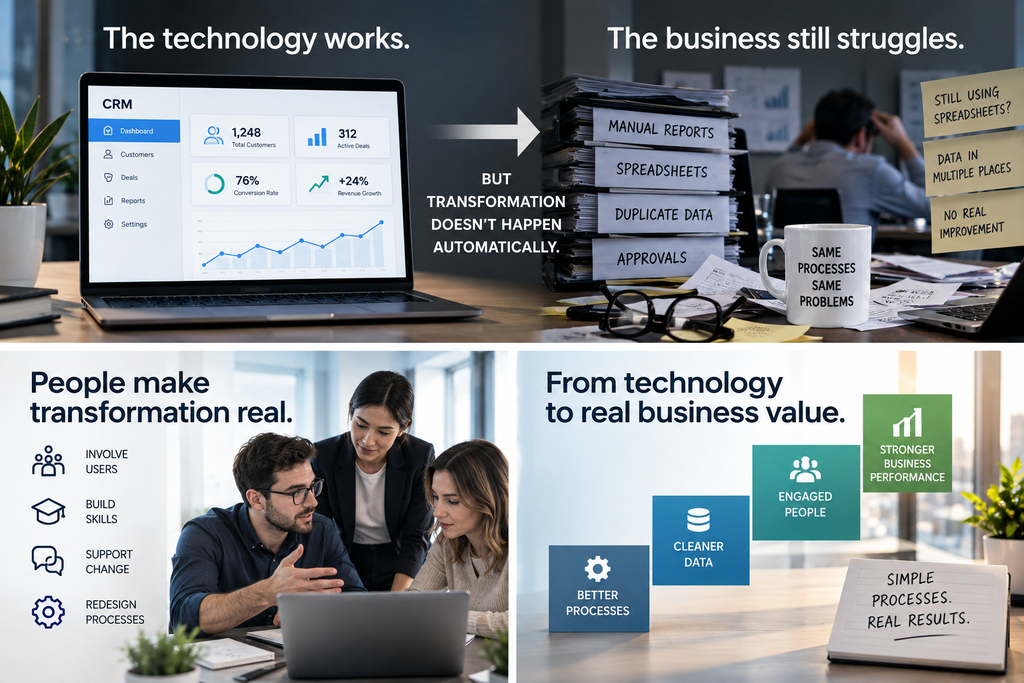
A process that previously required seven manual steps may now require three. Customer information may exist in one reliable location rather than four spreadsheets. Employees may spend less time preparing reports because information is generated automatically. Managers may be able to identify problems sooner because data is more reliable. Customers may receive answers faster because departments share the same information.
None of these outcomes requires technology to look futuristic.
What matters is that the organisation has improved.
The technology supports the change, but the value comes from the combination of better processes, clearer responsibilities, reliable data, capable employees and appropriate tools.
Digital Transformation Should Start With the Business
A stronger approach begins before software selection.
First, understand the existing process. Identify delays, duplication, unnecessary approvals, data problems and employee workarounds. Define what should improve and establish a baseline. Then decide which parts require process redesign, better information, employee development or technology.
Once a solution is selected, employees should be involved in its design and testing. Training should focus on the new way of working rather than only system features. Adoption should be measured after launch and the organisation should continue improving the process as real-world problems appear.
This may sound less exciting than announcing a major digital transformation programme.
It is also far more likely to create value.
The Technology Can Work and the Transformation Can Still Fail
The most important lesson is simple: a working system does not prove that a transformation has worked.
Software can operate perfectly while employees avoid using it. Automation can run correctly while automating an unnecessary process. A dashboard can calculate exactly what it was designed to calculate while using unreliable data. A project can launch on schedule while failing to improve the customer experience.
Technology is only one part of the transformation.
Successful digital transformation requires businesses to align technology, processes, data, people, skills and responsibility around a clearly defined business objective.
Instead of asking only:
“Did we implement the system successfully?”
businesses should ask:
“Did this change make the organisation work better — and can we demonstrate the improvement?”
That is the difference between installing technology and transforming a business.
Category: Digital Transformation
Sources
McKinsey & Company — What Is Digital Transformation?; McKinsey & Company — Lighthouse Lessons: Four Mindsets to Make Digital Transformation Stick; McKinsey & Company — What Really Works When It Comes to Digital and AI Transformations?; Deloitte — Manage Change With Digital Adoption Platforms; UK Department for Science, Innovation and Technology — Technology Adoption Review 2025 and Barriers and Enablers to Advanced Technology Adoption for UK Businesses; OECD — SME Digitalisation for Competitiveness: The 2025 OECD D4SME Survey; OECD — SME Technology Adoption in the United Kingdom (2026). (McKinsey & Company)