
When Growth Lowers Costs — and When It Starts Costing More
Growth is usually seen as a sign that a business is becoming stronger. More customers, more production and higher sales can allow a company to negotiate better prices, use equipment more efficiently and spread fixed costs across a larger number of products or customers. In economics, this is known as economies of scale: as output increases, the average cost of producing each unit can fall. OECD research on growing firms describes economies of scale as one of the reasons larger businesses can become more productive, particularly when fixed costs such as premises, software or equipment are spread across a greater volume of output. (OECD)
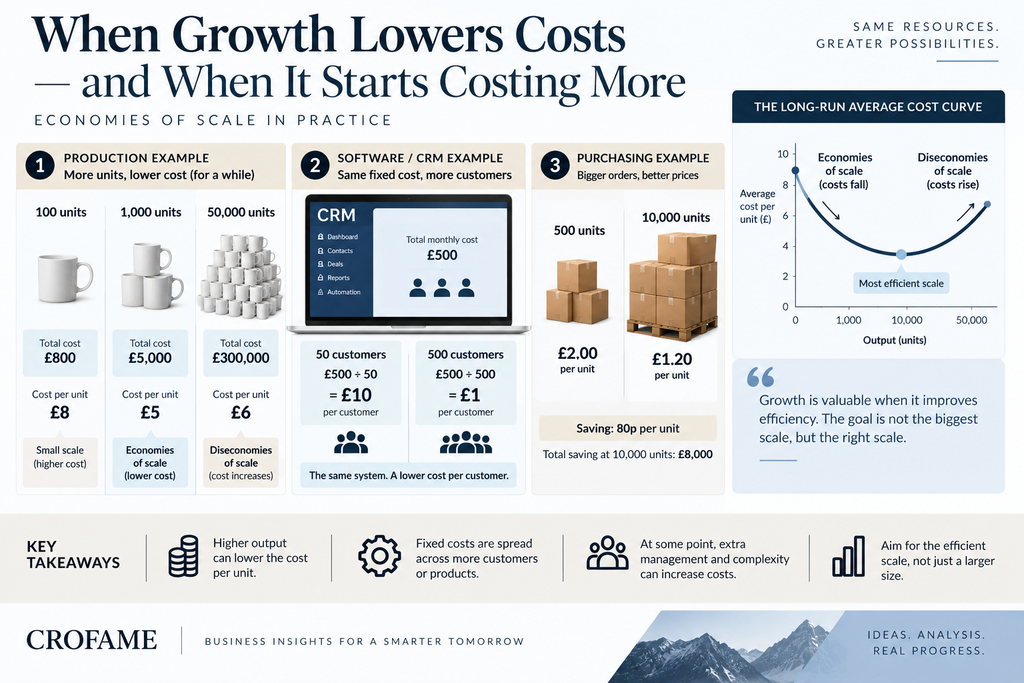
However, growth does not reduce costs forever. A business can eventually become so large or complicated that additional management, coordination, facilities and communication begin increasing costs again. This is known as diseconomies of scale. Understanding the difference can help businesses decide when expansion is improving efficiency and when growth is beginning to create unnecessary complexity.
Example 1: Producing More at a Lower Cost
A small company produces 100 products at a total cost of £800.
£800 ÷ 100 = £8 per unit
The company expands production to 1,000 units. Because it can purchase materials in larger quantities, negotiate better supplier prices and make better use of its equipment, total production costs rise to £5,000.
£5,000 ÷ 1,000 = £5 per unit
The company is now saving £3 on every unit produced. This is a simple example of economies of scale. The business is spending more overall, but every individual unit has become cheaper to produce. OpenStax describes the same economic principle: when output increases, average cost can fall because costs are spread over a greater quantity of production. (OpenStax)
For a business, this matters because lower unit costs can increase profit margins, allow more competitive pricing or provide additional money for investment. The benefit does not come simply from being a bigger company; it comes from using resources more efficiently as production expands.
Fixed Costs Become Cheaper Per Customer
Some of the clearest economies of scale appear when a company has costs that do not change much as customer numbers increase. These are known as fixed costs. Examples include rent, software subscriptions, website development, machinery or some administrative costs.
Example 2: The Same CRM, More Customers
A business pays £500 per month for its CRM system. With only 50 customers, the software cost per customer is:
£500 ÷ 50 = £10 per customer
If the company grows to 500 customers while the CRM still costs £500:
£500 ÷ 500 = £1 per customer
The technology has not become cheaper, but the business is using the same resource across many more customers. The average cost per customer has fallen by 90%.
OECD analysis specifically identifies this effect when discussing firm growth. Costs such as accounting software, websites, premises and other fixed resources can be distributed across a larger volume of business, allowing growing companies to operate at a more efficient scale. (OECD)
This is one reason digital businesses can sometimes scale particularly quickly. Once software has been developed, serving additional users may cost considerably less than developing the product in the first place. The OECD gives software companies as an example of businesses where large upfront development costs can be followed by relatively low additional production costs. (OECD)
Buying More Can Improve Negotiating Power
Scale can also change the relationship between a business and its suppliers. A company buying 100 boxes may have little negotiating power, while a company ordering 100,000 can often negotiate lower unit prices, better delivery terms or customised contracts. Similar benefits can appear in transport, insurance, advertising and professional services.
For example, if packaging costs £2 per unit when ordering 500 units but falls to £1.20 when ordering 10,000, the business saves 80p on every package. At 10,000 units, that represents an £8,000 saving. The advantage comes from volume, but the business still needs enough demand to use the larger order. Buying cheaply is not an economy if half of the stock remains unsold.
Better Use of Equipment and People
Businesses can also gain economies of scale by using expensive assets more effectively. A production machine may cost the same whether it operates for three hours or eight hours each day. A warehouse supervisor may be able to oversee a larger operation without their salary increasing proportionally. A finance team may process twice as many transactions after introducing better systems without doubling the number of employees.
This is where economies of scale and process optimisation often meet. Growth can create opportunities to redesign workflows, specialise roles and invest in technology that would not have been economically sensible for a much smaller operation.
A small manufacturer, for example, may initially pack products manually because purchasing an automated packing machine would cost more than the labour it saves. Once production increases substantially, the calculation can change. The same investment may then reduce the cost of thousands of units rather than hundreds.
But Bigger Is Not Always Cheaper
Economies of scale have limits. As organisations grow, they may need additional layers of management, larger facilities, more complex IT systems and more formal processes. Communication becomes harder because information must travel across more departments and locations. Decisions that were previously made in minutes may require several approvals.
At that point, the company can begin experiencing diseconomies of scale, where average costs rise as the organisation becomes larger. OpenStax describes this as the point on the long-run cost curve where increasing scale begins increasing average production cost rather than reducing it. (OpenStax)
Example 3: Growth Starts Increasing the Unit Cost
A company produces 10,000 units for £50,000.
£50,000 ÷ 10,000 = £5 per unit
It expands rapidly to 50,000 units, but now requires additional managers, a second warehouse, more administration and more complex logistics. Total costs rise to £300,000.
£300,000 ÷ 50,000 = £6 per unit
Although production has increased fivefold, the cost per unit has risen from £5 to £6. The company is larger, but it is no longer more efficient.
That additional £1 per unit becomes significant at scale. Across 50,000 units, it represents £50,000 of additional cost compared with producing at £5 per unit.
Management Can Become Part of the Cost
One reason diseconomies of scale appear is organisational complexity. A company with ten employees may have one manager and communicate informally. A business with 1,000 employees requires departments, reporting structures, HR processes, compliance systems and several levels of management.
Those systems may be necessary, but they cost money. OECD analysis notes that firms can grow until the internal costs of governance and coordination begin offsetting some of the advantages of scale. (OECD)
This does not mean management is waste. It means that expansion should be measured by efficiency as well as size. If every additional layer creates more approvals, slower decisions and duplicated reporting, the business may begin paying for complexity rather than benefiting from scale.
Growth Can Also Create Process Problems
A process that works for 50 customers may fail at 5,000. Manual spreadsheets become harder to maintain, communication becomes fragmented and employees may spend increasing amounts of time coordinating rather than completing productive work.
For example, a small company may approve purchases through a quick conversation with the owner. As it grows, it introduces several departments and multiple approval levels. If the process is poorly designed, buying a £200 item may eventually require four managers to approve it. The business has grown, but the process has become disproportionately expensive.
This is why scaling should involve more than simply doing more of the same. Businesses need to review whether systems, responsibilities and processes still make sense at the new size.
The Goal Is the Efficient Scale, Not the Biggest Scale
Economics does not suggest that every business should become as large as possible. The aim is to find a scale where resources are being used efficiently and average costs remain competitive. OECD research describes firms as seeking an efficient size where the benefits of scale can be captured without allowing internal transaction and organisational costs to outweigh them. (OECD)
For management, that means asking practical questions. Is cost per unit falling as output increases? Are fixed costs being used more efficiently? Are supplier discounts genuinely improving margins? Has growth required so much additional management and administration that those savings are disappearing? Are processes becoming faster or slower as the company expands?
Growth is valuable when it improves the economics of the business. More sales, more employees and more locations do not automatically mean better performance.
Growth Should Make the Business More Efficient
Economies of scale show why larger operations can often produce goods or services more cheaply. Fixed costs are spread across more output, purchasing power increases and expensive assets can be used more efficiently. But diseconomies of scale show the other side of growth: more managers, more communication, more facilities and greater complexity can eventually push costs upward.
The important measure is therefore not simply how much the business has grown, but what has happened to the cost of producing each unit, serving each customer or completing each transaction.
If 100 units cost £8 each and 1,000 cost £5 each, growth has created efficiency. If further expansion pushes the cost back to £6, management needs to understand why.
That is the practical value of economies of scale: growth should not only make a business bigger. It should make the business better at using its resources.
Category: Process Optimisation
Secondary category: Business Theory
Sources
OECD — Unleashing SME Potential to Scale Up (2025). The OECD explains how larger firms can gain productivity advantages by spreading fixed costs such as rent, software and website costs across a greater volume of output. (OECD)
OECD — Financing Growth and Turning Data into Business. Discusses efficient firm size, economies of scale and the point at which internal governance and transaction costs can reduce efficiency. (OECD)
OECD — Understanding Firm Growth. Includes examples of manufacturers expanding production capacity and software businesses benefiting from high initial development costs followed by relatively low additional production costs. (OECD)
OpenStax — Principles of Microeconomics 3e: Costs in the Long Run. Explains economies of scale, constant returns to scale and diseconomies of scale through changes in average cost as output expands. (OpenStax)