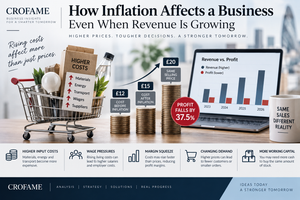
Revenue growth is usually treated as good news. More customers, more sales and a larger top-line figure can make a business look as though it is moving in the right direction. But revenue on its own does not tell us whether the company is becoming healthier, more profitable or more resilient.
A business can grow its sales while simultaneously weakening its financial position. Costs may be rising faster than revenue, margins may be shrinking, customer acquisition may be becoming more expensive and cash may be tied up in stock, unpaid invoices or expansion. In other words, growth can look impressive while creating more pressure underneath the surface.
McKinsey’s research on large public companies found that revenue growth is an important driver of long-term performance, but companies that combined growth with stronger profitability produced much better outcomes than companies focused on growth alone.

Revenue Is Not the Same as Profit
Revenue shows how much money a business generates from selling its products or services. Profit shows what remains after the costs of generating that revenue have been deducted.
The distinction sounds obvious, but it is often overlooked when organisations focus heavily on sales targets. Imagine a business that increases annual revenue from £1 million to £1.3 million. At first glance, 30% growth looks excellent. But if operating costs rise from £800,000 to £1.15 million at the same time, profit has actually fallen.
The company is bigger, busier and handling more transactions, but it is making less money from them.
Real-world company results regularly demonstrate that revenue and profitability do not necessarily move together. Deloitte UK, for example, reported that its FY2025 revenue decreased by 1% while distributable profit increased by 4%, illustrating how changes in cost management and business mix can affect profitability independently of headline revenue.
Margin Tells a Different Story
One of the first questions behind revenue growth should therefore be: What is happening to the margin?
If a company has to discount heavily to generate more sales, the additional revenue may contribute relatively little profit. The same problem can occur when supplier costs, wages, logistics, technology subscriptions or marketing expenditure increase faster than prices.
Consider two products. Product A generates £100,000 in sales with a 40% margin. Product B generates £150,000 but only a 10% margin. Looking only at revenue makes Product B appear more successful. Looking at profitability tells a very different story.
This is why businesses need to understand not only how much they sell, but which customers, products, services and channels are actually creating value.
Growth Can Consume Cash
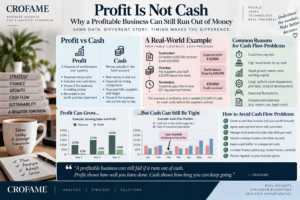
A growing company can also be profitable on paper and still struggle to pay its bills.
Growth often requires cash before the additional revenue is actually received. The business may need to purchase more stock, employ additional staff, invest in equipment or increase marketing spend. Customers may then take 30, 60 or even 90 days to pay invoices.
The British Business Bank notes that growth itself can create cash-flow pressure because each additional sale may require working capital, stock and customer credit before cash reaches the business. The UK Insolvency Service similarly warns that even businesses trading successfully can experience serious problems if they do not have enough cash available to meet their obligations.
This creates an important distinction: profit measures financial performance, while cash flow determines whether the business can continue paying its employees, suppliers, taxes and other obligations when they fall due.
More Customers Can Also Mean More Costs
Revenue growth is particularly dangerous when the cost of winning each new customer begins to rise.
Customer acquisition cost, or CAC, measures how much a business spends on sales and marketing to gain a new customer. If marketing expenditure rises faster than the value generated by those customers, additional sales can actually weaken profitability.
That is why businesses often compare CAC with customer lifetime value. A growing number of customers is much less attractive if each one is becoming significantly more expensive to acquire or if they only buy once and leave.
The Journal of Accountancy highlights CAC and customer lifetime value as important measures for understanding whether sales and marketing activity is actually contributing to profitable growth.
Not Every Customer Is Equally Valuable
Another common mistake is assuming that all revenue contributes equally to the business.
Some customers purchase frequently, pay quickly and require little support. Others negotiate large discounts, generate complaints, demand extensive customisation or pay invoices late. Both groups contribute revenue, but their impact on profitability can be completely different.
The same applies to products and services. A high-revenue service may require significant staff time, specialist support and repeated revisions. A smaller service may generate less revenue but much stronger margins and more predictable delivery.
This is where business analysis becomes important. Instead of asking only “Which products generate the most sales?”, businesses should also ask “Which products generate the most value after the full cost of delivery is considered?”
Operational Capacity Matters Too
Rapid growth can expose weaknesses that were manageable when the company was smaller.
Processes that worked with 100 customers may fail with 1,000. Manual spreadsheets become harder to control. Customer service queues grow. Managers spend more time solving operational problems. Errors increase because systems and responsibilities were never designed for the new scale.
Revenue may still be rising during this period, which can hide the deterioration for a while.
This is why sustainable growth requires operational capacity to increase alongside demand. The business needs systems, processes and people capable of supporting the larger organisation without allowing costs and complexity to grow uncontrollably.
Revenue Quality Matters More Than Revenue Alone
A useful way to think about business growth is through the quality of revenue.
High-quality revenue is typically profitable, repeatable and supported by manageable operating costs. It comes from customers the organisation can serve efficiently and from products or services that create sustainable value.
Lower-quality revenue may depend on constant discounting, expensive advertising, unusually high support requirements or one-off contracts that are difficult to repeat.
Two companies can therefore report the same growth rate while being in completely different positions. One may be building a stronger and more resilient business. The other may simply be increasing activity.
Look Beyond the Top Line
When revenue grows, management should therefore look at several measures together rather than celebrating one number in isolation.
Questions worth asking include: Are gross and operating margins improving or declining? Is cash flow keeping pace with growth? How much does it cost to acquire a customer? Which customers and products are most profitable? Are operational costs increasing faster than sales? Is the company becoming more efficient as it grows, or simply more complex?
These questions do not reduce the importance of revenue growth. They help determine whether that growth is actually creating value.
Healthy Growth Should Strengthen the Business
Growth should make a business stronger, not merely larger.
A company that increases sales while protecting margins, maintaining healthy cash flow, controlling acquisition costs and improving operational efficiency is building something sustainable. A company that grows revenue while margins collapse, cash becomes scarce and processes become overloaded may be moving in the opposite direction.
The most useful question is therefore not simply “Are sales increasing?”
It is: “Is this growth improving the overall health of the business?”
That distinction is central to business performance analysis. Revenue may be the most visible number, but the strongest businesses understand what sits behind it.
Category: Business Performance
Sources: McKinsey & Company — Revenue Growth: Ten Rules for Success and Which Metrics Really Drive Total Returns to Shareholders?; British Business Bank — What Is Cash Flow and How Do You Manage It?; UK Insolvency Service — Director Information Hub: Cashflow; Journal of Accountancy — Using Data to Optimize Marketing and Sales Strategies; Deloitte UK — Annual Review 2025 Metrics and Deloitte UK Publishes 2025 Financial Results.