Revenue growth usually looks positive. If a company sells more this year than last year, management may assume the business is becoming stronger. During periods of inflation, however, higher revenue does not necessarily mean higher profitability. A company can collect more money from customers while simultaneously paying more for materials, wages, energy, transport and other operating costs.
Inflation matters to businesses because it changes the value behind the numbers. The Bank of England defines inflation as the rate at which prices rise over time and notes that high or unstable inflation makes it harder for businesses to set prices and plan ahead. For management, this means revenue should not be considered in isolation; costs, margins and cash requirements also need to be examined. (Bank of England)
Higher Revenue Can Hide a Falling Margin
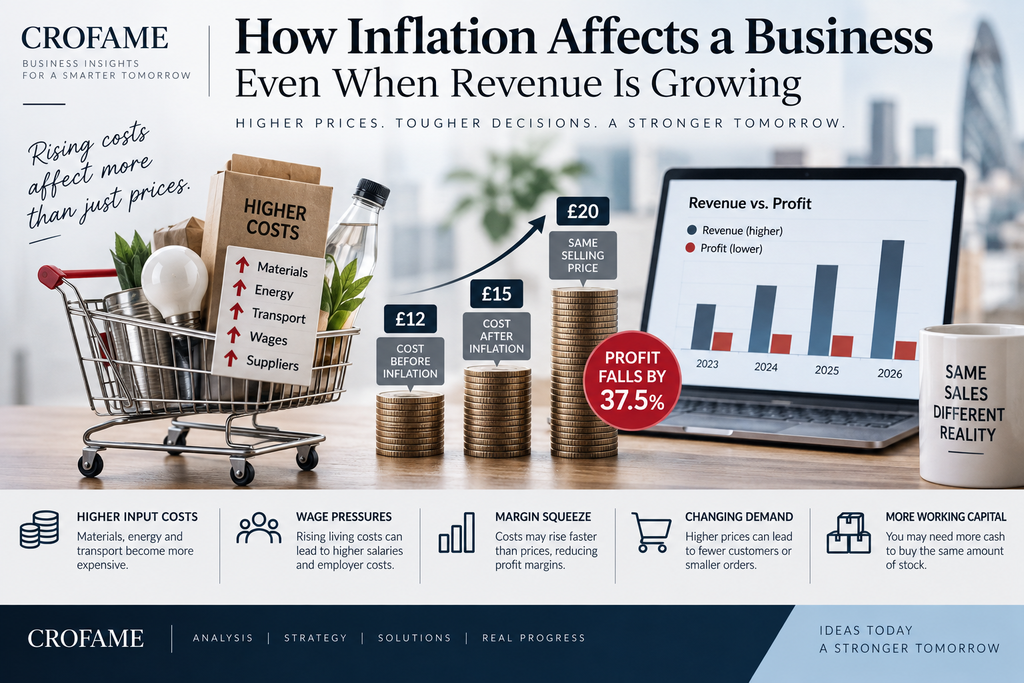
A business may increase its prices and report higher revenue without actually becoming more profitable. If input costs rise faster than selling prices, the amount of profit generated by each sale falls. This is often described as margin compression or a margin squeeze.
The situation is visible in current UK producer-price data. In July 2026, prices paid by UK manufacturers for inputs were 4.9% higher than a year earlier, while factory-gate output prices were 3.1% higher. The figures do not mean every business experienced the same change, but they illustrate an important principle: businesses cannot always pass their full cost increases on to customers. (Office for National Statistics)
Example: The Same £20 Sale Produces Less Profit
A product sells for £20. Before costs increase, producing it costs £12, leaving £8 gross profit and a 40% gross margin. If production costs rise to £15 while the selling price remains £20, gross profit falls to £5 and the gross margin drops to 25%.
£8 → £5 = a 37.5% fall in gross profit per unit.
The company is still making the same £20 sale, but the economics of that sale have deteriorated.
Businesses Cannot Always Increase Prices
One obvious response to rising costs is to charge customers more. In practice, businesses have to consider how customers are likely to react. A company with a distinctive product, strong customer loyalty or few competitors may have greater pricing power than a company selling something customers can easily buy elsewhere.
This creates a difficult decision. If prices remain unchanged, margins may shrink. If prices rise too far, some customers may reduce spending, delay purchases or choose a competitor. A company therefore needs to understand both its costs and the sensitivity of demand to price changes rather than simply adding the inflation rate to every product.
UK businesses regularly report this trade-off. In April 2026, 40% of trading businesses surveyed by the ONS said the prices of goods or services they bought had increased compared with the previous month, while only 16% reported increasing their own selling prices. Businesses considering price increases cited energy, labour, raw materials and transport among the main pressures. (Office for National Statistics)
Labour Costs Can Rise at the Same Time
Inflationary pressure does not stop with materials and energy. Employees also experience higher living costs and may seek higher wages, while employers can face changes in pensions, National Insurance and other employment expenses. For labour-intensive businesses, even a relatively small percentage increase across an entire workforce can materially change operating costs.
In May 2026, 66% of UK businesses with ten or more employees told the ONS that their staffing costs had increased during the previous three months. When asked how they might respond to further increases in employment costs, 44% said they could increase prices, 38% said they might absorb the increase in profit margins and 23% reported that reducing employee numbers was a possible response. (Office for National Statistics)
This shows why inflation becomes a management problem rather than simply a pricing problem. Businesses may have to balance profitability, staff retention, customer demand and competitiveness at the same time.
Inflation Can Increase the Amount of Cash a Business Needs
Another effect appears in cash flow. If a retailer previously needed £40,000 to replenish its stock and equivalent stock now costs £50,000, it needs an additional £10,000 of cash just to maintain roughly the same level of inventory.
The business has not necessarily expanded. It simply needs more money to finance the same operation.
This can create pressure even in profitable companies because suppliers may need to be paid before customers pay the business. The larger the gap between paying for stock or services and receiving customer payments, the more working capital the company requires. Inflation can therefore increase the amount of money tied up in day-to-day operations.
Not Every Cost Rises at the Same Rate
Businesses should also avoid thinking of inflation as one universal percentage applied equally to every expense. Energy prices may behave differently from wages, transport, imported materials or professional services. Some suppliers may increase prices substantially while others remain stable.
ONS data illustrates this variation. In June 2026, producer input prices were 7.3% higher than a year earlier, but within that overall figure crude oil, metals and chemicals experienced very different movements. (Office for National Statistics)
For management, this means a general inflation figure such as CPI is useful economic context, but company decisions should be based on the business’s actual cost structure. A restaurant, construction company, software business and logistics operator can experience the same economy very differently.
Revenue Growth Should Be Separated From Price Growth
Inflation can also make growth look stronger than it really is. Suppose a company increases its prices by 10% and sells exactly the same number of units as before. Revenue may rise by approximately 10%, but the business has not necessarily gained customers, increased production or improved productivity.
This is the difference between nominal growth and real growth. Nominal figures describe the money value measured at current prices, while real figures attempt to separate genuine increases in activity from changes caused by prices.
For internal business analysis, management does not always need a complicated economic model. A useful starting point is simply to ask whether revenue increased because the company sold more, because prices were higher, or because of both. That distinction provides much more information than the revenue number alone.
Cost Control Does Not Have to Mean Cutting Everything
Inflation can encourage businesses to reduce spending, but indiscriminate cost-cutting can create additional problems. Removing training, maintenance, marketing or experienced staff may improve short-term expenditure while weakening the company’s ability to operate or grow.
A stronger approach is to identify where costs are increasing and understand why. Supplier contracts can be reviewed, unnecessary process steps removed, waste reduced and product profitability compared. Businesses may also decide to stop selling products that generate significant revenue but very little margin.
The objective is not simply to spend less. It is to protect the activities that create value while reducing costs that do not.
Product Mix Becomes More Important
Inflation can affect individual products differently. One product may depend heavily on imported materials while another uses mainly domestic labour. One service may require significant travel, while another can be delivered digitally.
If costs change differently across the portfolio, the products generating the most revenue may no longer be the products generating the best profit. Management should therefore examine gross margin by product, customer or service rather than relying only on total company revenue.
This can lead to strategic decisions such as promoting higher-margin products, renegotiating supplier arrangements, redesigning an offering or discontinuing something that is no longer economically attractive.
Inflation Is Ultimately a Decision-Making Problem
Inflation affects businesses through several channels at once: supplier prices, wages, energy, transport, customer behaviour, pricing decisions and working-capital requirements. This is why simply comparing this year’s revenue with last year’s revenue can give an incomplete picture of performance.
A business can have higher sales, higher revenue and lower financial health at the same time if costs are rising faster than the value being created. The more useful questions are whether gross margin is holding up, whether customers are still buying at the new price, whether cash flow is sufficient and whether revenue growth represents real growth or simply higher prices.
The strongest businesses therefore look beyond the top line. During inflation, the important question is not only “Are we earning more?” but “After higher costs are taken into account, are we actually better off?”
Category: Business Performance
Secondary category: Business Theory
Sources
Office for National Statistics — Producer Price Inflation, UK: July 2026. UK manufacturer input prices were 4.9% higher year-on-year while factory-gate output prices were 3.1% higher. (Office for National Statistics)
Office for National Statistics — Business Insights and Impact on the UK Economy, May and June 2026. Covers changes in business purchase prices, labour costs and businesses’ responses to rising costs. (Office for National Statistics)
Bank of England — What Is Inflation? and Inflation and Interest Rates FAQs. Explains inflation, the UK’s 2% inflation target and why high or unstable inflation makes business planning and pricing more difficult. (Bank of England)