A business can be profitable on paper and still struggle to pay wages, suppliers or rent. Profit measures whether revenue exceeds costs over a period, while cash flow measures when money actually enters and leaves the bank account. The British Business Bank warns that even profitable businesses can experience serious cash-flow problems when they incur costs before customers pay them. (British Business Bank)
This distinction becomes particularly important for growing companies. More sales may increase profit, but they can also require more stock, more staff and more working capital before the additional revenue is collected.
A Sale Is Not the Same as Cash in the Bank
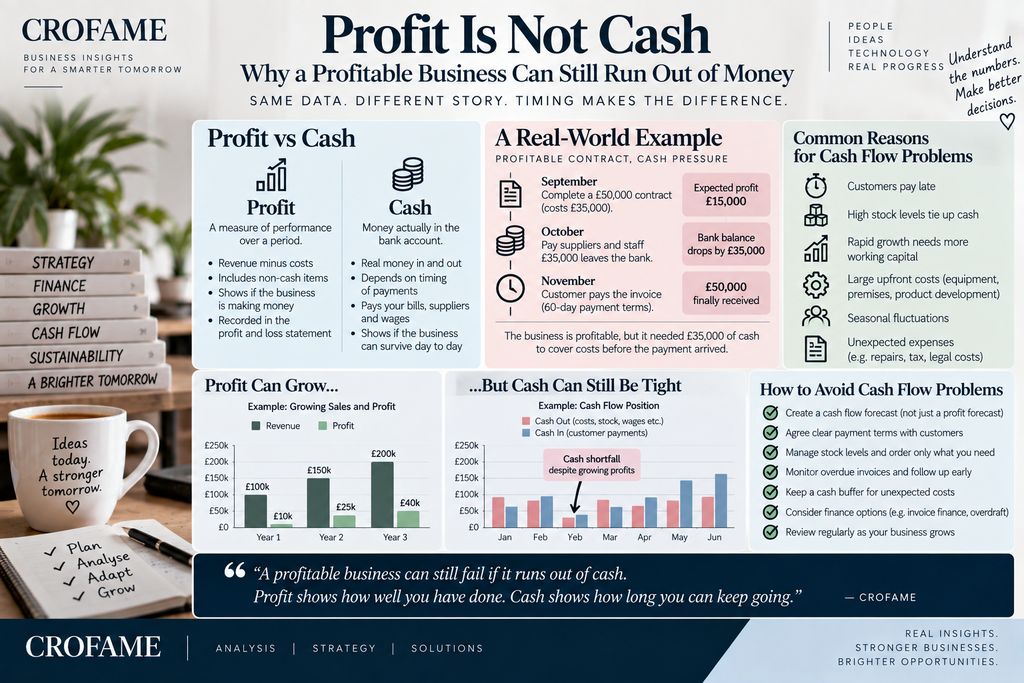
Imagine a business completes a £50,000 contract in September and invoices the customer on 60-day payment terms. The sale may contribute to September’s revenue, but the £50,000 may not reach the company’s bank account until November.
During those two months, the business may already have paid employees, suppliers, transport and other costs associated with delivering the contract. The company has made a profitable sale, but it still needs enough cash to survive while waiting to be paid.
Example: Revenue from contract: £50,000. Cost of delivering it: £35,000. Expected profit: £15,000. However, if the £35,000 must be paid now and the customer pays £50,000 in 60 days, the company first needs £35,000 of available cash. The contract is profitable, but it creates a short-term cash requirement.
The Insolvency Service notes that payment terms of 30 to 90 days are common and that delayed customer payments are a frequent cause of cash-flow difficulties. (GOV.UK)
Growth Can Make the Problem Worse
Rapid growth can increase cash pressure because every additional sale may need to be financed before the customer pays. More orders can require more raw materials, inventory, staff and delivery costs, so a business can become more profitable while simultaneously needing substantially more working capital.
The British Business Bank specifically warns that growth can create cash-flow difficulties because businesses must finance additional sales, carry more stock and often provide customers with credit. (British Business Bank)
Suppose a company normally sells £100,000 per month and needs £60,000 of working capital to support those sales. A large contract doubles monthly sales to £200,000, but the customer will not pay for 60 days. The company may need substantially more cash immediately to purchase materials and fund production. More business can therefore create a cash shortage rather than an immediate cash surplus.
Stock Can Contain Profit but Not Pay the Bills
Cash can also become trapped in inventory. A retailer may purchase £80,000 of stock expecting to sell it at a healthy margin, but until customers actually buy those products, the money remains tied up on shelves or in a warehouse.
The business may therefore own valuable inventory and expect future profit while having little cash available for today’s payroll or rent. Working capital management is partly about controlling this timing difference between paying for goods and receiving money from customers. (British Business Bank)
This is why increasing stock is not automatically a sign of financial strength. The important questions are how quickly the stock sells, how much cash is tied up in it and whether the business can continue paying its other obligations while waiting.
Late Payments Can Turn a Healthy Business Into a Cash Problem
A company may have excellent customers and profitable contracts but still experience difficulty if invoices are consistently paid late. This is particularly important for smaller suppliers because one large outstanding invoice can represent a significant proportion of their available cash.
For example, a company may have £120,000 in unpaid invoices and only £15,000 in its bank account. On paper, the balance sheet may appear reasonably strong, but salaries of £25,000 are due next week. Unless customers pay or the company accesses additional working capital, it has a liquidity problem.
Invoice finance exists partly because businesses can have significant value locked inside unpaid invoices. The British Business Bank explains that invoice finance allows firms to obtain funding against money customers already owe them rather than waiting for the normal payment date. (British Business Bank)
Profit Can Be Reinvested Before It Becomes Available Cash
Another reason profit and cash differ is investment. A business may generate £100,000 of profit but use much of its available cash to purchase machinery, expand premises or develop a new product.
Those investments may strengthen the company and create future growth, but the money is no longer available for everyday expenses.
The same applies when a business repays debt or makes other large payments. A company therefore needs to understand not only whether it is profitable, but also where its cash is going and when future payments will become due.
Working Capital Keeps the Business Operating
Working capital is the money a business needs for everyday operations while it waits for revenue to arrive. It covers expenses such as wages, rent, suppliers and utilities.
The British Business Bank notes that businesses need enough working capital to cover the entire cash-flow cycle: producing or delivering the service, issuing the invoice and then waiting for the customer to pay. The longer that cycle, the more working capital the company generally needs. (British Business Bank)
This makes working capital especially important for businesses with long projects, large stock requirements or customers that expect extended credit terms.
Cash-Flow Forecasting Shows the Problem Before It Arrives
A profit-and-loss statement tells management what the business has earned and spent over a period. A cash-flow forecast answers a different question: Will enough money actually be available when payments are due?
A useful forecast records expected cash receipts according to when customers are likely to pay and then compares them with expected outgoings such as salaries, rent, materials, tax and loan payments. The British Business Bank recommends forecasting the actual timing of cash receipts rather than simply recording when invoices are issued. (British Business Bank)
For example, management may discover that the business is expected to be profitable for the year but will face a £30,000 cash shortfall in November. Knowing this in August gives the company time to accelerate customer payments, delay non-essential spending, renegotiate supplier terms or arrange appropriate finance.
Profitability and Liquidity Answer Different Questions
Profitability asks: Is the business creating more economic value than it costs to operate?
Liquidity asks: Does the business have enough accessible cash to meet its obligations when they become due?
A company needs both. A business that continually loses money cannot usually survive indefinitely, but neither can a profitable company that repeatedly runs out of cash. HMRC guidance explicitly notes that a business can be profitable and still fail because its income and expenditure are badly out of sync. (GOV.UK)
This is why management should monitor profit, bank balances, receivables, stock, upcoming payments and cash-flow forecasts together rather than relying on one headline number.
A Profitable Business Can Still Fail
The practical lesson is simple: profit does not pay a bill until the profit has actually turned into cash.
A business may have strong sales, healthy margins and valuable customer contracts while still facing a serious problem if customers pay too slowly, too much money is tied up in stock or growth requires more working capital than the company has available. The Insolvency Service describes insufficient cash as one of the most significant factors in company failure, even where a business is otherwise trading effectively. (GOV.UK)
Management should therefore ask two questions separately: “Are we profitable?” and “Will we have enough cash available when our bills become due?” A strong business needs the answer to both questions to be yes.
Category: Business Performance
Secondary category: Business Theory
Sources
British Business Bank — What Is Cash Flow and How Do You Manage It? Explains the distinction between cash flow and profit and why rapid growth can increase cash requirements. (British Business Bank)
British Business Bank — Working Capital: Why It’s Important to Your Business. Covers the cash-flow cycle, working-capital requirements and the risk faced by profitable businesses unable to meet short-term obligations. (British Business Bank)
British Business Bank — How to Create a Cash Flow Forecast in 4 Steps. Explains how businesses should forecast receipts and expenditure according to when cash actually moves. (British Business Bank)
The Insolvency Service — Director Information Hub: Cashflow. Explains the importance of liquidity, payment delays and cash-flow management during business growth. (GOV.UK)
HM Revenue & Customs — Cash Flow and Cash Flow Covenants. Notes that profitable businesses can still fail when cash receipts and expenditure become out of sync. (GOV.UK)