A pay rise can make an employee happier, but it does not automatically make the job more interesting, improve a poor manager or create opportunities for development. This is the central idea behind Herzberg’s Two-Factor Theory, one of the best-known theories of workplace motivation. Frederick Herzberg argued that the factors causing dissatisfaction at work are not necessarily the same factors that create genuine satisfaction and motivation. (Harvard Business Review)
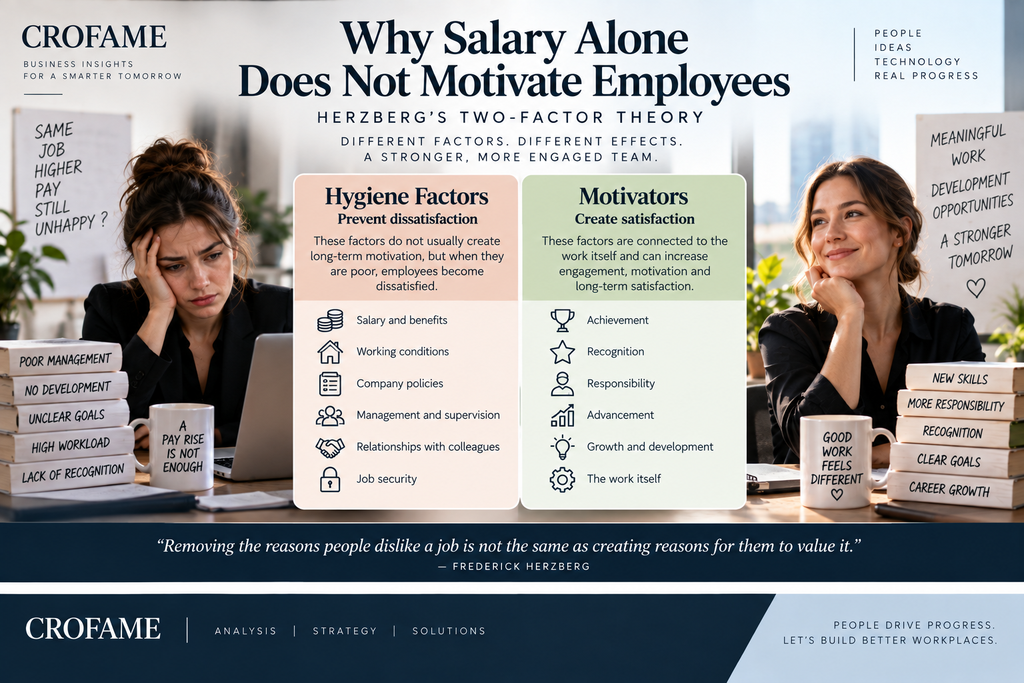
Herzberg divided workplace factors into two broad groups: hygiene factors and motivators. Hygiene factors include salary, working conditions, company policies, supervision, relationships and job security. Motivators include achievement, recognition, responsibility, advancement, growth and the nature of the work itself. (CIPD)
Hygiene Factors: What Stops Employees Becoming Dissatisfied
Hygiene factors do not mean that salary or working conditions are unimportant. Quite the opposite: when these areas are poor, employees may become dissatisfied very quickly. Low pay, unfair treatment, weak management, unpleasant working conditions or insecurity can make an otherwise interesting role difficult to tolerate.
Herzberg’s argument was that improving these conditions may remove dissatisfaction without necessarily creating strong long-term motivation. An employee who receives fair pay and has a competent manager may stop being unhappy, but that does not automatically mean they feel challenged, recognised or interested in developing within the organisation. (CIPD)
Example: The Pay Rise Does Not Fix the Job
An employee earns £30,000 and feels dissatisfied because the manager rarely provides feedback, there is no clear progression and most of the work is repetitive. The company increases the salary to £33,000. The employee may appreciate the additional money, but the underlying problems remain: the work is still repetitive, the manager is still poor and there is still no development path.
The pay rise may reduce one source of dissatisfaction, but it has not changed the job itself. This is exactly the distinction Herzberg was trying to make.
Motivators: What Can Make Work More Meaningful
Herzberg argued that stronger motivation comes from factors connected to the work itself. These include completing something meaningful, being trusted with responsibility, receiving recognition, developing expertise and having opportunities to progress.
For example, an employee may become more engaged when they are given ownership of a project rather than simply completing isolated tasks. A manager can also increase responsibility gradually, provide meaningful feedback and allow an employee to see how their work contributes to a larger result.
Herzberg later developed the idea of job enrichment, where roles are designed to contain more achievement, responsibility, challenge and opportunity for growth rather than relying mainly on external rewards. (Harvard Business Review)
Good Pay and Interesting Work Are Not Substitutes for Each Other
The theory can sometimes be misunderstood as suggesting that money does not matter. That would be too simplistic. If an employee believes they are badly paid, a certificate of recognition or a more interesting project may not compensate for it.
The opposite is also true. High pay may not compensate indefinitely for a role with poor management, no autonomy and no opportunity to develop. Businesses therefore need to consider both sides: employees need acceptable working conditions and fair reward, but they may also need meaningful reasons to remain engaged.
A useful management principle is therefore: fix serious sources of dissatisfaction first, then create conditions that allow motivation to grow.
Recognition Can Matter — but It Needs to Be Meaningful
Recognition is one of Herzberg’s motivators, and later workplace research also suggests that effective recognition can influence morale, performance and retention. Harvard Business Review has reported that employees respond positively when managers regularly recognise genuinely good work rather than treating recognition as an occasional symbolic exercise. (Harvard Business Review)
Recognition also needs to match the situation. A public announcement may motivate one employee and embarrass another. Someone expecting a pay review may not consider a thank-you email an adequate substitute. Modern research therefore reinforces an important point: employees do not all respond to the same incentives in exactly the same way. (Harvard Business Review)
Responsibility Can Motivate — but Only When Support Exists
Giving employees more responsibility can increase a sense of ownership and achievement, but simply increasing workload is not job enrichment. If someone receives more duties without authority, support, resources or recognition, the result may be additional stress rather than motivation.
A useful distinction is between more responsibility and more work. Responsibility means greater control, decision-making and ownership. More work simply means adding tasks.
For example, asking an employee to manage a small project from beginning to end can provide development. Giving that same employee another twenty routine tasks without changing their authority does not create the same effect.
Why Managers Still Use Herzberg’s Theory
The theory remains popular because it provides a simple way to diagnose different workplace problems. If employees are complaining about pay, policies, management or conditions, the business may have a hygiene problem. If working conditions are reasonable but employees appear bored or disengaged, the business may need to examine responsibility, recognition, progression and job design.
It is especially useful because it prevents organisations from treating every motivation problem as a salary problem. Compensation matters, but managers also need to ask whether employees are learning, progressing, being trusted and receiving meaningful feedback.
But Herzberg’s Theory Has Important Limitations
Herzberg’s model should not be treated as a proven formula. CIPD’s evidence review notes that although the theory remains widely discussed in management literature, its central claims have not received strong empirical support and were challenged by later research. (CIPD)
Employee motivation is more complicated than dividing every workplace factor into two fixed categories. Salary can motivate some people strongly, particularly when financial security or performance-related reward matters. Recognition may matter enormously to one employee and very little to another. Career stage, personality, family circumstances, job type and organisational culture can all influence what people value.
For that reason, Herzberg is best used as a management framework for asking better questions, not as a rule predicting exactly how every employee will behave.
The Practical Lesson for Businesses
A business trying to improve motivation should not rely on one intervention. Increasing salaries while ignoring poor management may not solve the problem. Introducing recognition programmes while salaries remain unfair may also fail. Offering promotions will not help much if employees are overloaded and distrust management.
A stronger approach is to examine both the basic employment environment and the quality of the work itself. Are employees paid fairly? Do they feel secure and respected? Are policies reasonable? Then ask whether people have meaningful responsibility, recognition, opportunities to learn and a realistic path to progression.
Herzberg’s theory remains useful because it highlights a simple business reality: removing the reasons people dislike a job is not necessarily the same as creating reasons for them to value it.
Salary matters. Working conditions matter. Management matters. But for many employees, sustainable motivation also depends on whether the work provides achievement, recognition, responsibility and growth.
Category: Business Theory
Secondary category: Business Performance
Sources
Frederick Herzberg — One More Time: How Do You Motivate Employees?, Harvard Business Review. Herzberg explains the distinction between factors causing dissatisfaction and those associated with motivation and job satisfaction. (Harvard Business Review)
William J. Paul Jr., Keith B. Robertson and Frederick Herzberg — Job Enrichment Pays Off, Harvard Business Review, 1969. Discusses job enrichment through greater achievement, responsibility, recognition and opportunities for growth. (Harvard Business Review)
CIPD — Work Motivation: An Evidence Review. Summarises Herzberg’s motivation-hygiene theory and also discusses the limited empirical evidence supporting its original claims. (CIPD)
Harvard Business Review — Do You Tell Your Employees You Appreciate Them? Discusses evidence linking meaningful recognition with morale, performance and retention. (Harvard Business Review)
Harvard Business Review — What Really Motivates You at Work? Discusses differences in how employees respond to different types of recognition and reward. (Harvard Business Review)