Digital transformation does not have to begin with a large software project, consultants or an expensive custom platform. For many small businesses, the best starting point is simply replacing repetitive manual work with affordable digital tools that solve one clear problem at a time.
This matters because cost, time and uncertainty are among the biggest barriers to digital adoption for SMEs. The UK SME Digital Adoption Taskforce found that adoption often feels too difficult or expensive, while many businesses lack the expertise or confidence to choose and implement the right tools. OECD research similarly identifies cost and relevance as two of the most important barriers for UK SMEs. (GOV.UK)
Start With the Process That Wastes the Most Time
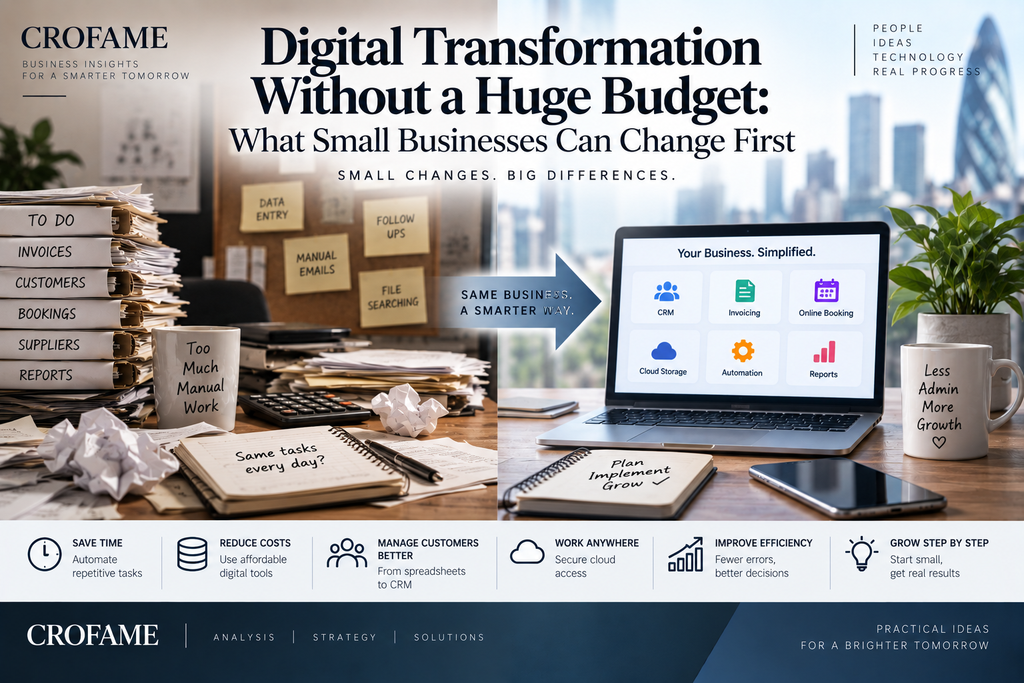
A small business does not need to digitise everything at once. It should first identify where employees repeatedly lose time: entering the same customer details into several places, manually sending reminders, searching for documents, checking bookings or preparing reports.
Example: A business spends five hours every week manually updating customer records and sending follow-up emails. If a simple CRM reduces this to one hour, the company saves around four hours per week, or more than 200 working hours per year.
The important point is that the transformation begins with the problem, not with the software.
Replace Spreadsheets Only When They Become a Problem
Spreadsheets can work perfectly well for a very small operation. The problem begins when several employees maintain different versions, customer information becomes inconsistent or important follow-ups are forgotten.
At that point, a basic CRM may be more useful than another spreadsheet. Customer details, previous conversations, tasks and follow-ups can be stored in one place, allowing employees to see the same information.
The UK SME Digital Adoption Taskforce specifically identifies CRM, accounting, e-commerce and resource-planning systems as productivity-enhancing technologies that can help smaller firms operate more efficiently. (GOV.UK)
Automate the Small Administrative Tasks First
Many useful automations do not require AI. A booking form can create an appointment automatically. An accounting system can send an overdue-payment reminder. A website enquiry can create a CRM record. A customer can receive an automatic confirmation after placing an order.
Each automation may save only a few minutes, but repeated hundreds of times the benefit becomes significant.
Example: If an employee manually sends 20 appointment confirmations every day and each takes two minutes, that is 40 minutes per day. Automation can remove much of that routine work without changing the service itself.
This type of improvement is often more realistic for a small company than trying to redesign the entire organisation at once.
Move Important Files Into Shared Cloud Systems
Another relatively low-cost improvement is moving working documents from individual computers or email attachments into controlled shared cloud storage. This reduces problems such as duplicate versions, missing files and employees repeatedly asking which document is current.
Cloud technology is already one of the more mature digital technologies used by UK SMEs, and OECD research notes that basic digital capabilities such as cloud computing are much more widely adopted than advanced automation or robotics. (OECD)
The benefit is simple: employees spend less time searching for information and more time using it.
Use Digital Invoicing Before Buying Complex Finance Software
A business may not need a sophisticated ERP system to improve its finances. Moving from manually created invoices to basic digital accounting and invoicing software can already reduce administrative work.
Invoices can be generated from existing customer information, payment status can be tracked and reminders can be sent automatically. The company gains better visibility of unpaid invoices without requiring someone to check every account manually.
For a small business, this is a good example of digital transformation that is relatively inexpensive but directly connected to cash flow.
Introduce Online Booking Where It Removes Repetitive Calls
Businesses that rely heavily on appointments can often gain quick benefits from online booking. Customers select available times themselves, while the system can send confirmation and reminders automatically.
This does not mean removing telephone support. Customers with unusual requirements can still speak to someone. The system simply removes routine scheduling from employees who could spend that time on customers who genuinely need assistance.
A hair salon, consultant, fitness instructor, therapist or repair service may therefore achieve meaningful digital improvement with one relatively small tool.
Connect Existing Tools Before Buying New Ones
Small businesses sometimes already own most of the technology they need but use each system separately. Customer information sits in one platform, invoices in another and bookings somewhere else.
Before purchasing another product, it is worth asking whether the existing tools can be connected.
A website form that automatically creates a CRM contact and sends information into an accounting system can remove several manual steps. The technology may already exist; the missing element is integration.
This is especially important because OECD research identifies interoperability and skills gaps as long-standing barriers to SME digitalisation. (OECD)
Do Not Pay for Features the Business Does Not Need
A common digital-transformation mistake is choosing the most powerful system instead of the most appropriate one. A small company may buy an enterprise platform containing hundreds of features when it really needs customer records, automated reminders and simple reporting.
That creates unnecessary cost and complexity.
A better approach is to define the minimum requirement first. What problem needs solving? Which features are essential? How many employees will use them? What will the business stop doing manually after implementation?
If the new system adds another layer of work instead of removing one, it may not be the right solution.
Build Around One Measurable Improvement
Every small digital project should have a measurable objective. The business might want to reduce invoice preparation from three hours per week to one, reduce missed appointments, eliminate duplicate data entry or shorten customer response times.
Without a baseline, it is difficult to know whether the investment actually helped.
The Department for Business and Trade’s research on SME technology adoption found that businesses value technology most when it solves a clear operational problem and when they receive practical, relevant support during adoption. (GOV.UK)
That means “becoming more digital” is not a strong objective. Reducing a five-step manual process to two steps is.
Digital Transformation Can Start Small
A small business does not need to replace every system, automate every task or introduce AI across the organisation. In many cases, the strongest first moves are much simpler: a CRM instead of multiple spreadsheets, online booking instead of repeated scheduling calls, digital invoicing instead of manual reminders, shared cloud documents instead of emailed copies, or connecting systems so the same information does not need to be entered repeatedly.
The goal is not to spend as much as possible on technology. It is to identify where a modest investment can remove a recurring problem.
Digital transformation becomes manageable when it is treated as a series of practical improvements rather than one enormous project. Start with the work that wastes the most time, fix one process, measure the result and then decide what should change next.
Category: Digital Transformation
Secondary category: Process Optimisation
Sources
UK Department for Business and Trade — SME Digital Adoption Taskforce: Final Report (2025), covering barriers including cost, execution support and perceived switching risk. (GOV.UK)
UK Department for Business and Trade — Understanding Technology Adoption Among UK SMEs (2025), examining how SMEs adopt productivity-enhancing software and the problems they try to solve. (GOV.UK)
UK Department for Business and Trade — SME Digital Adoption Taskforce: 2026 Update. (GOV.UK)
OECD — SME Technology Adoption in the United Kingdom (2026), covering adoption patterns and barriers including cost, relevance and skills. (OECD)
OECD — The Digital Transformation of SMEs and Digitalisation of SMEs, covering digital skills, interoperability, financing and technology-adoption barriers. (OECD)