Digital transformation does not have to begin with artificial intelligence, robotics or a large technology programme. For many businesses, it starts with something much simpler: replacing paper forms, spreadsheets, manual bookings and repeated data entry with connected digital systems that make everyday work faster and easier to manage.
This matters because small inefficiencies accumulate. A paper form that has to be retyped, an invoice sent manually, a booking written into a calendar or a customer record stored in several places may seem minor, but together they create delays, errors and unnecessary administration. UK research published in 2025 found that SMEs often adopt technology when it clearly solves day-to-day operational problems, particularly in areas such as customer invoicing, inventory management and workflow management. (GOV.UK)
From Paper Forms to Digital Data
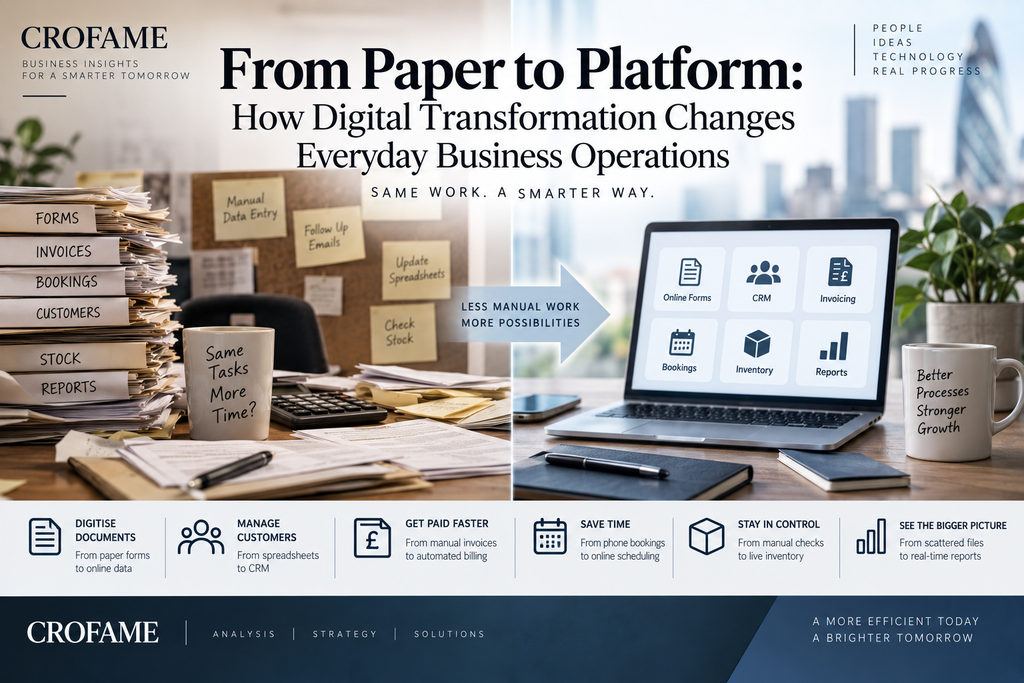
A paper form may still collect the information a business needs, but the information often has to be transferred somewhere else afterwards. An employee may read the form, type the details into a spreadsheet and then enter the same customer information into another system. A digital form can send the information directly into a database or CRM, reducing repeated data entry and creating one consistent record.
Example: A customer completes a paper registration form containing their name, address and contact details. An employee spends five minutes entering it into the system. If the business processes 500 forms each month, that is over 41 hours of manual data entry. A connected online form can remove much of that work.
From Spreadsheets to CRM
Spreadsheets are useful, particularly when a company is small, but they can become difficult to manage as the number of customers grows. Different employees may create separate versions, updates can be missed and nobody is completely certain which file contains the latest information.
A CRM provides a central customer record where sales, communication, enquiries and follow-up activity can be managed together. The UK Small Business Survey found that CRM use rises substantially with business size: around 26% of micro businesses using relevant digital tools reported CRM use, compared with 42% of small businesses and 54% of medium-sized businesses. (GOV.UK)
Example: Instead of keeping one Excel file for leads, another for existing customers and emails containing follow-up notes, a CRM holds the information in one place. When the customer calls, employees can immediately see previous conversations, current status and what needs to happen next.
From Manual Invoices to Digital Invoicing
Traditional invoicing can involve creating an invoice manually, converting it to PDF, emailing it to the customer and later checking the bank account to see whether payment arrived. Digital accounting and invoicing systems can generate invoices from existing customer data, track their status and automatically send reminders when payment becomes overdue.
HMRC research published in 2026 found that only 29% of surveyed UK SMEs reported using structured e-invoicing, despite much broader familiarity with the concept. PDF and email remained common methods, showing that even relatively basic business processes still have considerable scope for further digitalisation. (GOV.UK)
Example: Instead of an employee checking outstanding invoices every Friday and manually emailing ten customers, the accounting system can identify overdue invoices automatically and send scheduled reminders. The employee becomes involved only when payment remains unresolved.
From Telephone Bookings to Online Booking
A business that manages appointments by telephone needs someone to answer calls, check availability, enter the booking and possibly contact the customer again if the appointment changes. An online booking system allows customers to see available times themselves and make or change appointments without waiting for an employee.
This does not remove the need for customer service. It removes a repetitive part of customer service. Employees can spend more time handling questions, unusual requests and customers who genuinely need assistance rather than repeatedly performing basic scheduling.
Example: A beauty salon receives 20 booking calls a day, each taking around four minutes. That is approximately 80 minutes of staff time every day. Moving routine bookings online can release much of that time while still allowing customers to call when necessary.
From Manual Stock Checks to Live Inventory
Stock management is another area where digital transformation changes everyday operations. A business using paper lists or periodically updated spreadsheets may not know exactly what is available until someone physically checks the stockroom.
A digital inventory system can update quantities when goods are sold, received or moved. Employees can see current stock levels, identify products approaching minimum levels and reduce the chance of selling products that are no longer available. OECD analysis notes that SMEs commonly adopt digital tools when they clearly address operational problems such as inventory management and quality control. (OECD)
Example: A retailer discovers that a popular product is out of stock only when a customer orders it. With live inventory, the system can flag low stock earlier and trigger a reorder before sales are lost.
From Local Files to Cloud Working
Digital transformation can also be as simple as changing where documents are stored. When important files exist only on one computer, employees may email copies to one another, creating several versions of the same document. Cloud storage allows authorised employees to access and update the same file from different locations.
The OECD identifies cloud computing as an important part of SME digitalisation because it gives smaller firms access to storage, software and computing resources without requiring the same level of upfront hardware investment. (OECD)
The operational benefit is often straightforward: fewer duplicate files, easier collaboration and less time asking, “Which version is the latest one?”
Digital Transformation Is About Connecting Work
Replacing a paper form with an online form is useful, but greater value appears when systems begin working together. A customer completes a form, the information enters the CRM, the CRM creates a task for the relevant employee, the accounting system receives the correct billing information and management can see the activity in a dashboard.
Without integration, businesses can simply replace disconnected paper processes with disconnected digital processes. The OECD notes that SMEs tend to adopt simpler digital tools first, while more integrated systems such as CRM, ERP and supply-chain management remain less common, particularly among smaller firms. (OECD)
That is an important distinction. Digitalising a document is not the same as transforming a process.
Start With the Everyday Problems
Small businesses do not need to transform everything at once. A better starting point is to look for recurring friction: information being entered twice, customers waiting for routine responses, employees producing the same report manually or documents being moved between several people before anything happens.
The Department for Business and Trade’s research into SME adoption found that businesses value technologies that solve clear productivity problems, while uncertainty about which solution to choose can itself become a barrier to adoption. (GOV.UK) This suggests a practical approach: identify the problem first and then choose technology that genuinely improves the process.
From Digital Tools to Better Operations
The purpose of digital transformation is not to create a workplace containing as much technology as possible. The purpose is to reduce unnecessary work, improve access to information, make processes more reliable and allow employees to spend more time on activities that require judgement or customer interaction.
For one business, transformation may mean replacing a paper booking book with an online system. For another, it may mean connecting CRM, accounting and inventory platforms so information moves automatically between them. The scale is different, but the principle is the same: technology creates value when it improves how work actually gets done.
Category: Digital Transformation
Secondary category: Process Optimisation
Sources
Department for Business and Trade — Understanding Technology Adoption Among UK SMEs (2025). Research into how UK SMEs adopt productivity-enhancing digital technologies and the problems businesses attempt to solve through adoption. (GOV.UK)
Department for Business and Trade — SME Digital Adoption Taskforce: Final Report and 2026 Update. Covers adoption of technologies including cloud computing, CRM and resource-planning software among UK SMEs. (GOV.UK)
OECD — The Digital Transformation of SMEs and SME Technology Adoption in the United Kingdom. Covers CRM, cloud computing, process integration, digital invoicing and the operational barriers faced by SMEs. (OECD)
HM Revenue & Customs — Electronic Invoicing: SME Usage and Attitudes (2026). Research into the use of e-invoicing among UK SMEs. (GOV.UK)
Department for Business and Trade — Longitudinal Small Business Survey 2024. Includes UK SME use of accountancy software, electronic invoicing, CRM, payroll and booking software. (GOV.UK)