SWOT analysis is one of the simplest strategic tools a business can use to understand its position before making an important decision. It looks at four areas: Strengths, Weaknesses, Opportunities and Threats. Strengths and weaknesses are internal factors the business can influence, while opportunities and threats come from the external environment. Used properly, SWOT helps management compare what the company is capable of with what is happening in the market. (business.gov.au)
The value of SWOT is not the four-box table itself. The value comes from using the information to decide what the business should do next. Government guidance describes SWOT as a way to identify priorities, possible future challenges and opportunities, while Cambridge’s Institute for Manufacturing describes it as a way to match internal capabilities with external trends. (GOV.UK)
Strengths and Weaknesses: What Is Happening Inside the Business?
Strengths are resources or capabilities that help the company compete. They may include a strong brand, experienced staff, loyal customers, good supplier relationships, specialist knowledge, cash reserves or an efficient production process. Weaknesses are internal limitations such as limited funding, poor systems, high staff turnover, weak marketing or dependence on one major customer. (business.gov.au)
The important point is to be specific. “Good customer service” is much less useful than “70% of new customers come from referrals and customer retention is above 90%.” The more evidence behind each point, the more useful the SWOT becomes.
Opportunities and Threats: What Is Changing Outside the Business?
Opportunities are external developments the company may be able to use to its advantage. These can include a growing market, new technology, changing customer behaviour, new distribution channels or competitors leaving the market. Threats are external developments that could damage performance, such as stronger competitors, regulation, rising costs, supply disruption or weakening demand. (business.gov.au)
Because these factors sit outside the organisation, the company cannot fully control them. It can only decide how to respond. This is why SWOT is often useful before entering a new market, launching a product or making a large investment.
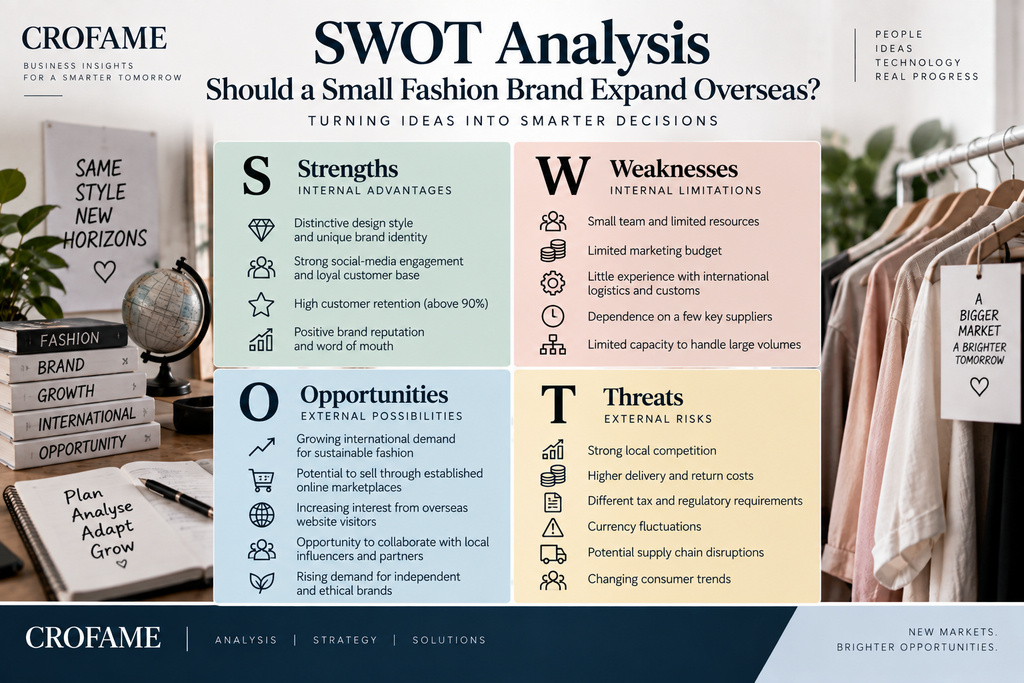
Example: Should a Small Fashion Brand Expand Overseas?
Imagine a UK fashion brand considering selling in another European market.
Its Strengths are a distinctive design style, strong social-media engagement and loyal existing customers. Its Weaknesses are a small team, limited marketing budget and little experience with international logistics. Its Opportunities include growing overseas interest, customers already visiting the website from that country and the possibility of using an established marketplace rather than opening a physical store. Its Threats include higher delivery and return costs, stronger local competitors and possible regulatory or tax differences.
The SWOT does not automatically tell management “expand” or “do not expand.” Instead, it reveals what needs to happen before the decision is made. The company could use its strong online following to test demand with a limited launch, use a marketplace to reduce the initial infrastructure required, and investigate logistics and returns before committing significant money.
That is the practical value of SWOT: it turns a general idea into a clearer set of strategic questions.
SWOT Becomes More Useful When the Factors Are Connected
A common mistake is to fill in four boxes and stop. The analysis becomes much stronger when the business asks how the four areas interact.
For example, how can a strength be used to exploit an opportunity? A company with a strong brand may use it to enter a growing market. How can a strength reduce a threat? Strong cash reserves may help the company survive a temporary decline in demand. Which weakness could prevent the business from using an opportunity? A company may see strong international demand but lack the operational capacity to serve it.
The Australian government’s business guidance recommends using SWOT in exactly this way: build on strengths, reduce weaknesses, use strengths to take advantage of opportunities and develop strategies to minimise threats. (business.gov.au)
SWOT Can Help Compare Different Options
SWOT can also be used when a business has several possible strategies. HM Treasury’s 2026 Green Book notes that SWOT may be used when comparing options against objectives and critical success factors. (GOV.UK)
A company deciding how to grow might compare three options: opening another physical location, expanding through e-commerce, or partnering with an existing distributor. Each option can have its own strengths, weaknesses, opportunities and threats. The analysis does not make the decision automatically, but it gives management a structured way to compare alternatives rather than relying only on instinct.
SWOT Has Limits
SWOT is useful, but it should not be treated as a complete decision-making model. Research has criticised traditional SWOT analysis because businesses can produce long lists of vague factors without prioritising or verifying them. SWOT also does not automatically tell management which factor is most important or how much weight each factor should receive. (ScienceDirect)
This is why a good SWOT should be short, evidence-based and connected to a specific decision. Ten carefully selected factors are usually more useful than forty generic observations.
For major decisions, SWOT can also be combined with other tools. PESTLE can examine the wider political, economic, social, technological, legal and environmental environment, while financial analysis, scenario planning and market research can test whether an attractive-looking opportunity is economically realistic. The Open University specifically notes that SWOT is commonly used alongside tools such as PESTLE when analysing an organisation’s external environment. (The Open University)
SWOT Is a Starting Point, Not the Final Decision
SWOT analysis works best when it forces management to look at a decision from more than one direction. It prevents a company from focusing only on the attractive part of an opportunity while ignoring internal weaknesses or external threats.
Its strongest use is not asking, “What are our strengths and weaknesses?” but asking, “Given our strengths, weaknesses and what is changing around us, what should we do next?”
A good SWOT does not predict the future. It helps a business enter the future with a clearer understanding of what it can use, what it needs to fix, what opportunities are worth pursuing and what risks need to be managed.
Category: Business Theory
Secondary category: Business Strategy
Sources
Australian Government — Do a SWOT Analysis. Practical guidance on strengths, weaknesses, opportunities, threats and turning the analysis into strategy. (business.gov.au)
University of Cambridge, Institute for Manufacturing — SWOT. Defines SWOT as a way to match environmental trends with internal capabilities. (IfM)
UK Government — The Futures Toolkit. Describes SWOT as a method for identifying strategic priorities, future challenges and opportunities. (GOV.UK)
HM Treasury — The Green Book 2026. Notes that SWOT can be used when comparing strategic options. (GOV.UK)
Open University — Strategic Planning and SWOT Analysis. Explains the distinction between internal strengths and weaknesses and external opportunities and threats. (The Open University)
Hill & Westbrook — SWOT Analysis: It’s Time for a Product Recall, Long Range Planning. Discusses common weaknesses of poorly conducted SWOT analysis, including vague factors and lack of prioritisation. (ScienceDirect)