A business does not compete only with companies selling the same product. Its profitability can also be affected by suppliers, customers, new competitors and alternative products that solve the same problem in a different way. Michael Porter’s Five Forces framework was designed to help businesses look at this wider competitive environment and understand where pressure on profits is coming from. Porter first introduced the model in 1979 and later expanded it, arguing that competition should be understood as a struggle over economic value across the whole industry, not simply as a battle between existing rivals. (Harvard Business Review)
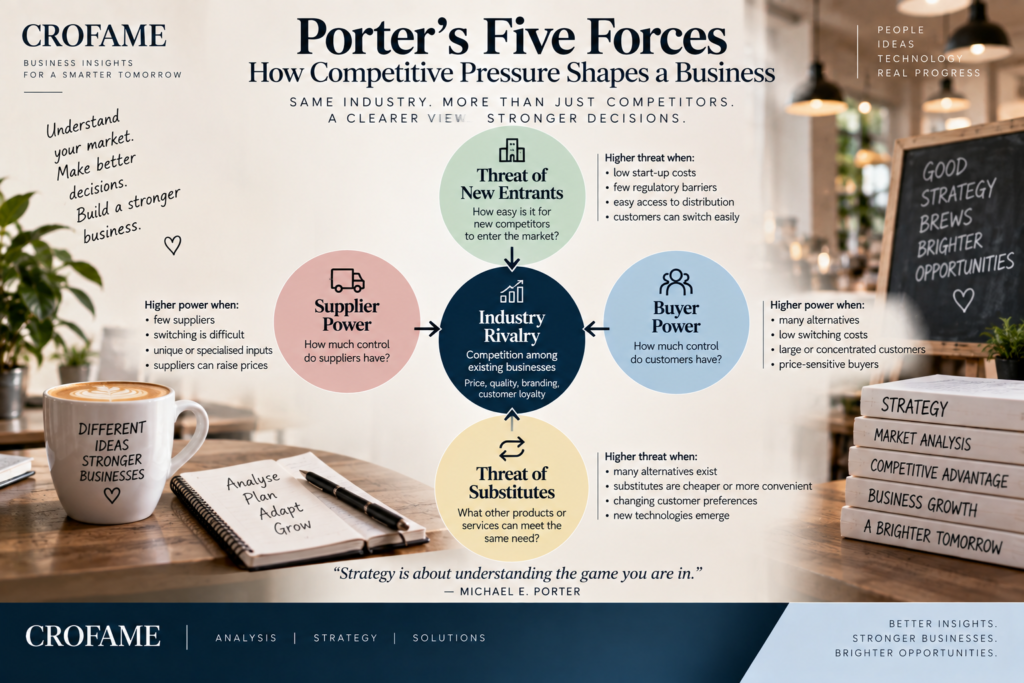
The five forces are competitive rivalry, threat of new entrants, bargaining power of suppliers, bargaining power of buyers and threat of substitutes. The University of Cambridge’s Institute for Manufacturing describes the framework as a way of diagnosing industry structure and understanding how direct and indirect competition can erode long-term profitability. (IfM)
1. Competitive Rivalry
Competitive rivalry looks at the businesses already operating in the market. If many companies offer similar products and customers can switch easily, firms may be forced to compete through lower prices, promotions, advertising or better service.
Imagine an independent coffee shop located on a street with six other cafés. If customers see little difference between them, the shop may struggle to increase prices because customers can simply walk next door. Strong rivalry can therefore reduce margins even when customer demand is high.
Competition becomes less damaging when a business has something customers value that is difficult to copy, such as a distinctive brand, location, specialist product, strong community reputation or superior customer experience.
2. Threat of New Entrants
A profitable market can attract new competitors. The threat is higher when starting a competing business is relatively easy and does not require significant capital, specialist knowledge, licences or established distribution.
For the coffee shop, a new independent café may be able to enter the local market fairly easily compared with a business trying to build an aircraft manufacturer or pharmaceutical company. The existing café therefore needs to consider whether its customers would remain loyal if another attractive option opened nearby.
Porter’s framework identifies barriers such as economies of scale, brand identity, capital requirements, access to distribution and switching costs as factors affecting the threat of new entrants. (IfM)
A business that has strong customer loyalty, an excellent location or exclusive supplier relationships may therefore be better protected than one competing only on price.
3. Bargaining Power of Suppliers
Suppliers have greater power when a business depends heavily on a small number of them or when changing supplier would be difficult or expensive. A powerful supplier may be able to increase prices or impose less favourable terms, which can reduce the buyer’s profit margin. (IfM)
For example, our coffee shop may rely on one specialist roaster because customers specifically value that coffee. If the roaster increases prices by 15%, the café has several choices: accept a smaller margin, raise prices or switch supplier and risk changing the product customers like.
The same principle applies across industries. A manufacturer dependent on one specialist component supplier or a software company dependent on a critical platform can face significant supplier power.
The strategic question is therefore not simply “How much does this supplier charge?” but “How dependent are we on them, and how easily could we replace them?”
4. Bargaining Power of Buyers
Customers also have bargaining power. Their power tends to increase when they have many alternatives, can compare prices easily or can switch providers at little cost. Large customers can have even more power because losing one contract could materially affect the supplier’s revenue. Porter treats buyer power as one of the forces that can capture value away from companies within an industry. (Harvard Business Review)
A person buying one coffee has limited negotiating power, but they can still choose another café. A large corporate customer ordering catering for hundreds of employees may have much stronger negotiating leverage and can ask for discounts, extended payment terms or customised service.
A business that depends on one customer for 40% of its revenue is therefore in a very different strategic position from a business with thousands of smaller customers.
5. Threat of Substitutes
A substitute is not necessarily a direct competitor. It is another product or service that satisfies the same customer need.
For a coffee shop, substitutes could include making coffee at home, buying an energy drink, using an office coffee machine or choosing a convenience store rather than visiting another café. These businesses may never describe themselves as direct competitors, but they still compete for the same customer spending.
Porter emphasises that competition extends beyond existing rivals to substitute products because alternatives can limit how much customers are willing to pay. (Harvard Business Review)
This is why businesses need to ask not only “Who sells the same thing as us?” but also “What else could the customer choose instead?”
Example: A Coffee Shop Considering a Second Location
Suppose an independent coffee shop is performing well and the owner is considering opening a second branch.
A Five Forces analysis might show that rivalry is high because several established cafés operate nearby. The threat of new entrants is medium because opening a small café is relatively achievable. Supplier power is low to medium because several coffee roasters are available, although changing the main supplier could affect product quality. Buyer power is high because customers can easily switch cafés, and the threat of substitutes is high because customers can make coffee at home or buy it from supermarkets and convenience stores.
The analysis does not automatically say that the second location is a bad idea. Instead, it reveals that competing purely on price could be difficult. The business may need a stronger point of difference, such as specialist coffee, faster service, an attractive workspace, a subscription programme or a location where direct competition is weaker.
This is how Five Forces becomes useful: the framework does not make the decision; it helps management understand the pressures surrounding the decision.
Five Forces Can Explain Why a Growing Market Is Still Difficult
One of Porter’s important arguments is that a fast-growing industry is not automatically a highly profitable industry. Strong supplier power, intense rivalry, easy market entry or powerful customers can absorb much of the value created even when demand is increasing. (Harvard Business Review)
For example, demand for food delivery may grow rapidly, but if customers compare prices easily, restaurants have many platform choices and competitors continually offer discounts, growth in the overall market does not guarantee strong profits for every participant.
This is an important distinction between market attractiveness and market growth. High demand is useful, but businesses also need to understand who has the power to capture the value created by that demand.
The Framework Can Help a Business Find a Better Position
Five Forces is most useful when it leads to strategic action. If rivalry is intense, the business may differentiate its offer rather than compete only on price. If supplier power is high, it may diversify suppliers. If customers have strong bargaining power, the company may reduce dependence on a few large accounts. If substitutes are becoming more attractive, the business may need to improve convenience, quality or customer experience.
Porter describes strategy partly as finding a position where competitive forces are weaker or developing ways to respond to them more effectively. (Harvard Business Review)
The framework therefore helps shift the conversation from “Who are our competitors?” to the more useful question “Where is pressure on our profitability actually coming from?”
Porter’s Five Forces Has Limits
The model should not be treated as a complete business strategy. It mainly analyses the competitive structure of an industry and does not automatically evaluate the company’s own capabilities, financial condition or internal weaknesses.
This is why it works well alongside tools such as SWOT, financial analysis, customer research and scenario planning. SWOT can examine the company’s internal strengths and weaknesses, while Five Forces focuses more strongly on external competitive pressure.
Markets can also change quickly, particularly when technology alters customer behaviour or creates entirely new substitutes. A Five Forces analysis should therefore be reviewed rather than completed once and forgotten.
A Better Way to Look at Competition
Porter’s Five Forces helps businesses understand that competition is broader than the companies appearing next to them in Google search results. Suppliers can take more value through higher prices, customers can demand better terms, substitutes can reduce demand and new entrants can increase competitive pressure.
A business should therefore ask five straightforward questions: How intense is rivalry? How easily can new competitors enter? How much power do our suppliers have? How much power do our customers have? What alternatives could replace what we sell?
The answers do not tell management exactly what to do, but they can reveal where the business is vulnerable and where it may have room to build a stronger competitive position.
Category: Business Theory
Secondary category: Business Strategy
Sources
Michael E. Porter — How Competitive Forces Shape Strategy, Harvard Business Review, 1979. Original introduction of the competitive-forces framework. (Harvard Business Review)
Michael E. Porter — The Five Competitive Forces That Shape Strategy, Harvard Business Review, 2008. Porter’s updated explanation of the model and its implications for industry structure and profitability. (Harvard Business Review)
University of Cambridge, Institute for Manufacturing — Porter’s 5 Forces. Practical overview of the five forces and the factors influencing entry barriers, supplier power, buyer power, rivalry and substitutes. (IfM)