Modern working life often rewards visible productivity. Long hours, constant availability and packed schedules can create the impression that someone is highly committed and successful. But productivity is difficult to sustain when sleep, health, relationships, financial security or basic recovery are continually neglected.
This is where the idea of self-care becomes more useful than it may initially sound. Self-care is not simply taking a bath, buying something enjoyable or taking an occasional day off. At its most practical level, it means protecting the physical, emotional and social conditions that allow a person to function well over time. Work-life balance is part of the same idea: work should be important, but it should not consume every resource a person needs for the rest of life.
The relationship between wellbeing and work is increasingly visible in workplace data. CIPD’s 2025 research found that 23% of employees reported feeling exhausted and 21% felt under excessive pressure, while a quarter believed work was having a negative effect on both their mental and physical health. High workload was one of the most commonly reported contributors to poor mental health. (CIPD)
Maslow’s Hierarchy of Needs
One way of understanding why balance matters is through psychologist Abraham Maslow’s hierarchy of needs. In his 1943 paper A Theory of Human Motivation, Maslow proposed that human motivation involves several groups of needs that have different levels of priority. The model later became widely represented as a pyramid, although Maslow’s original theory was more flexible than the simple staircase often shown today. (DOI)
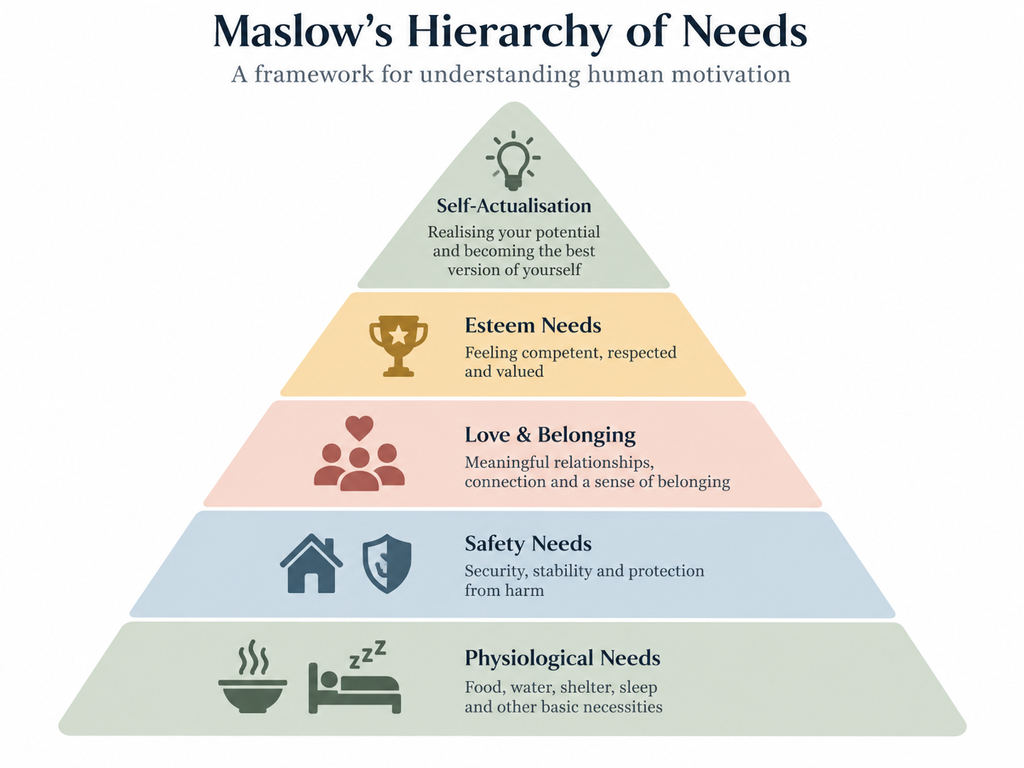
At the bottom of the familiar pyramid are physiological needs: food, water, sleep, rest and the basic physical requirements of life. Above them are safety needs, including stability, security, shelter and protection from danger. The next level concerns love and belonging, such as relationships, friendship, family and connection with other people. Above this are esteem needs, including confidence, recognition, achievement and a sense of competence. At the top is self-actualisation, the desire to develop, create, fulfil potential and do work or activities that feel meaningful.
The model does not mean that every lower need must be completely satisfied before a person can care about anything above it. People can pursue several needs at the same time. Its value is in showing that human performance does not exist separately from the rest of human life.
What Does the Pyramid Have to Do With Work?
Consider someone trying to perform at a high level while regularly sleeping five hours a night. Their career goals may belong near the top of the pyramid, but one of the most basic physiological needs is being neglected.
Now imagine an employee who earns enough to survive but is constantly worried about losing their job. They may be expected to innovate, contribute ideas and plan for the future, yet much of their attention is being consumed by the more immediate need for security.
Someone else may have a stable job and good salary but feel isolated, excluded or unsupported by colleagues. The problem is no longer food or financial survival, but the need for connection and belonging.
This is why organisations can sometimes offer employees career-development programmes, motivational workshops or ambitious performance targets and still see disengagement. Higher-level opportunities do not automatically compensate for problems lower down the structure.
A person cannot always “motivate” themselves out of chronic exhaustion, insecurity or isolation.
Self-Care Starts at the Bottom of the Pyramid
Self-care is often presented as something optional that happens after work is finished. Maslow’s model suggests almost the opposite: some forms of self-care provide the foundation that makes other achievements possible.
Sleep is a good example. So are regular meals, physical movement, periods of recovery and time away from work. These activities can appear unproductive because they do not generate an immediate business output, but removing them does not create unlimited additional capacity.
There is a limit to how long a person can exchange recovery for productivity before performance begins to suffer.
The World Health Organization defines mental wellbeing not simply as the absence of illness but as a state that enables people to cope with stresses, realise their abilities, learn, work and contribute to their communities. WHO also estimates that depression and anxiety account for around 12 billion lost working days globally every year. (World Health Organization)
Self-care therefore should not be viewed only as comfort. It can also be maintenance.
Work-Life Balance Does Not Mean Working Less All the Time
Work-life balance is sometimes misunderstood as trying to minimise work or maintain a perfect 50/50 division between professional and personal life.
Real life rarely works that way.
There may be periods when work legitimately requires more attention: launching a company, completing an important project, preparing for an examination or dealing with a temporary crisis. At other times, family, health or personal responsibilities need to take priority.
Balance is better understood as the ability to move between these demands without allowing one part of life to permanently destroy the others.
A demanding week followed by recovery is different from six months of constant exhaustion. Working late occasionally is different from developing a culture where employees are expected to be permanently reachable. Ambition itself is not the problem. The problem begins when there is no mechanism for recovery.
Safety Is More Than Physical Safety
The second level of Maslow’s hierarchy is usually described as safety. In modern working life, that can include physical safety, but also financial and psychological security.
An employee who does not know whether their contract will continue, whether they will be able to pay their housing costs or whether one mistake will result in humiliation may find it difficult to concentrate fully on development and creativity.
Psychological safety also matters. People need to be able to ask questions, admit that they do not understand something and raise concerns without expecting punishment or ridicule.
This does not mean workplaces should remove accountability. Good performance still requires standards, feedback and responsibility. But fear and accountability are not the same thing.
Belonging Is a Business Issue Too
The middle of the pyramid reminds us that people are social.
Relationships outside work matter because they provide identity, support and connection beyond a job title. When work consistently removes time from friendships, family or community, the consequences may not be immediately visible on a performance dashboard, but they still affect the person doing the work.
Belonging also matters inside organisations. Employees who feel connected to colleagues and supported by managers are likely to experience work differently from those who feel isolated.
CIPD’s 2025 findings are particularly interesting here: poor relationships with colleagues were the most frequently reported driver of negative effects on employees’ mental health in its employee data, ahead even of high workload. (CIPD)
A workplace can therefore provide excellent technology, competitive salaries and attractive offices while still creating a poor experience if relationships are dysfunctional.
Achievement Matters — but It Cannot Be the Only Source of Worth
The higher levels of Maslow’s model include esteem: achievement, recognition, competence and respect.
Work can satisfy many of these needs. Completing difficult projects, receiving recognition, earning promotions and developing expertise can all contribute to confidence and identity.
That can be positive. Problems appear when work becomes the only source of self-worth.
If a person’s entire sense of value depends on productivity, every quiet period may feel like failure. Rest may create guilt. A rejected application, unsuccessful project or redundancy can become not simply a professional disappointment but a threat to identity.
Healthy ambition allows someone to care deeply about achievement without believing that their value disappears when they stop producing.
This is another role of self-care and life balance: maintaining parts of identity that exist outside work.
Self-Actualisation Is Not Simply Career Success
At the top of the familiar pyramid is self-actualisation. It is often interpreted as becoming extremely successful, but that is too narrow.
Self-actualisation is closer to developing potential and becoming capable of doing work and living in ways that feel meaningful. For one person that may involve building a company. For another it may involve creative work, parenting, research, learning, community contribution or developing expertise without wanting senior management responsibility.
This distinction matters because modern career culture can sometimes treat promotion as the universal measure of progress.
But not everyone wants the same outcome.
A person can be ambitious without wanting to become a director. Someone may value expertise over status, independence over hierarchy or flexibility over a larger salary.
A sustainable career therefore needs some alignment between what a person is pursuing and what they actually value.
Self-Care Is Also About Boundaries
Practical self-care often means recognising limits before the body or mind imposes them automatically.
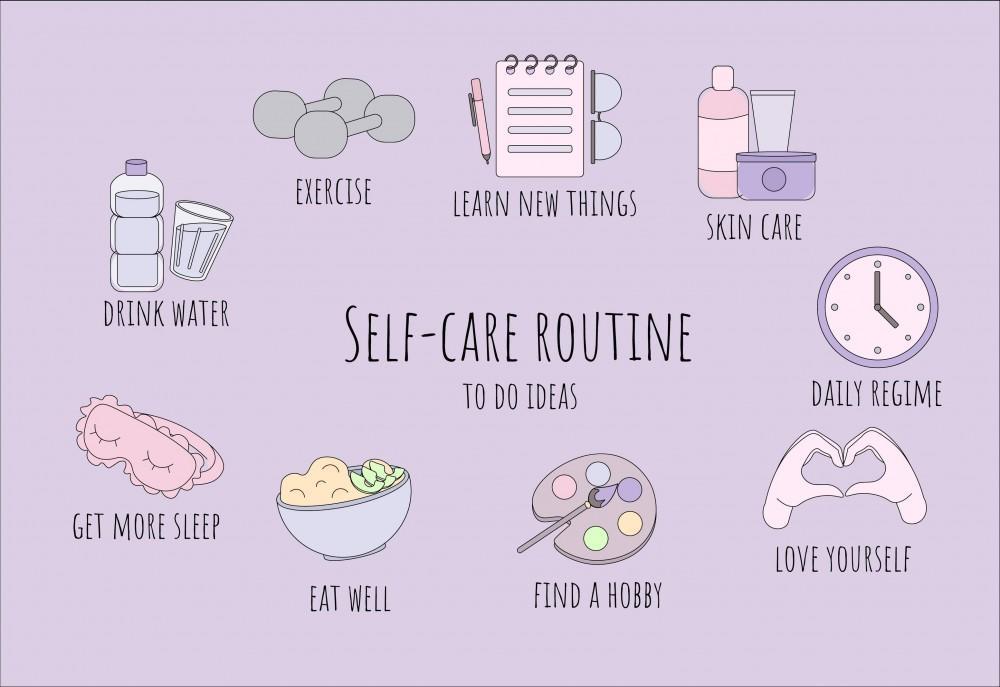
That might mean protecting sleep instead of repeatedly working into the night, eating properly during busy periods, taking annual leave rather than allowing it to accumulate indefinitely, maintaining relationships outside work, switching off notifications during genuine downtime and recognising when workload has become unrealistic.
It can also mean asking for help earlier rather than waiting until a situation becomes unmanageable.
For employers, promoting self-care while maintaining workloads that make it impossible is unlikely to solve much. CIPD recommends a more holistic and preventative approach to wellbeing, including addressing psychosocial risks at work rather than relying solely on support after problems appear. (CIPD)
An organisation cannot tell employees to protect their wellbeing while simultaneously rewarding permanent overwork.
Work-Life Balance Can Improve Performance Rather Than Compete With It
The assumption that wellbeing and performance sit on opposite sides of a scale is misleading.
There will always be short-term situations where additional effort increases output. But sustainable performance depends on whether people can continue functioning effectively over months and years rather than only during one intense week.
CIPD reports that employees who believed work negatively affected their mental health were substantially less likely to be satisfied in their jobs, less willing to recommend their employer and more likely to consider leaving. They were also less likely to report going above and beyond or making innovative suggestions. (CIPD)
This is relevant to business performance because replacing employees, managing absence and operating with disengaged teams all have organisational consequences.
Wellbeing is therefore not separate from performance. In many circumstances, it is one of the conditions that makes performance sustainable.
The Pyramid Can Be Used as a Simple Life Check
Maslow’s hierarchy can also be used as a practical framework rather than only a psychological theory.
Instead of asking only, “Am I productive enough?”, someone can examine the different levels of their life. Am I sleeping and eating properly? Do I feel reasonably secure? Do I have relationships and connection outside work? Do I feel competent and respected? Am I developing towards something that matters to me?
A weakness in one area does not mean everything else must stop. But it can explain why simply pushing harder is not always producing better results.
Sometimes the next step towards better performance is another qualification, a new business strategy or a more ambitious goal.
Sometimes it is eight hours of sleep.
A Sustainable Life Supports Sustainable Work
Self-care and work-life balance should not be reduced to occasional treats or corporate wellbeing campaigns. At their core, they are about maintaining the foundations that allow people to work, develop, build relationships and pursue meaningful goals without continuously exhausting the resources required to do so.
Maslow’s hierarchy remains influential because it illustrates something simple: human beings have multiple needs, and achievement is only one of them.
Work can provide income, security, belonging, confidence and purpose. It can be an important part of a fulfilling life. But when work begins damaging the very foundations that allow someone to function, higher productivity is unlikely to be the long-term result.
The objective is not to choose between ambition and wellbeing.
It is to build a life in which ambition can continue without requiring wellbeing to be sacrificed for it.
Category: Business Performance
Sources: Abraham H. Maslow — A Theory of Human Motivation, Psychological Review (1943); World Health Organization — Guidelines on Mental Health at Work; World Health Organization — Mental Health at Work; CIPD — Health and Wellbeing at Work 2025; CIPD — Wellbeing at Work factsheet. (DOI)