A business can make good internal decisions and still be affected by events completely outside its control. Interest rates change, customer behaviour shifts, new technology appears, regulations are introduced and environmental pressures influence costs and expectations. PESTLE analysis helps businesses examine these external forces before they become operational problems or missed opportunities.
PESTLE stands for Political, Economic, Social, Technological, Legal and Environmental factors. Unlike SWOT, which looks at both internal and external issues, PESTLE focuses specifically on the environment surrounding the organisation. CIPD describes it as a framework for identifying external influences that can affect strategy, costs, risks and future opportunities. (CIPD)

Political: What Could Policy Change?
Political factors include government policy, taxation, trade arrangements, tariffs, public spending and regulation. A company cannot control these decisions, but it can consider how exposed its business model is to them.
For example, a retailer importing products from overseas may be more sensitive to changes in trade rules or tariffs than a local service company. A construction company may be affected by public infrastructure spending, while another industry may be more exposed to changes in taxation or environmental policy. The point is not to predict every government decision, but to identify which political developments could materially affect the business. (CIPD)
Economic: What Happens If Customers Have Less Money?
Economic factors include inflation, interest rates, wages, exchange rates, unemployment, economic growth and consumer spending. These variables can affect both the company’s costs and the amount customers are willing or able to spend. (CIPD)
Imagine a business selling premium furniture. Its products and management remain exactly the same, but household borrowing costs rise and customers become more cautious about large purchases. Demand may weaken even though the company itself has done nothing wrong. At the same time, higher wages, transport or materials costs may reduce margins.
This is why economic analysis should sit alongside sales forecasts. Demand depends partly on the wider financial environment, not simply on how good the product is.
Social: Customer Behaviour Can Change Without the Product Changing
Social factors include demographics, lifestyles, cultural expectations, attitudes towards work, health, convenience and changing consumer preferences. (CIPD)
A restaurant may discover that customers increasingly prefer delivery or takeaway. A fashion company may see stronger interest in resale or sustainability. An employer may find that candidates now place more value on flexibility and work-life balance.
The company may still offer exactly the same product or employment package as before, but the market around it has changed. PESTLE encourages management to ask whether customer and employee expectations are moving faster than the organisation.
Technological: New Technology Can Change the Competitive Standard
Technology does not have to destroy an industry to affect it. Sometimes it simply changes what customers expect.
Online booking, mobile payments, automation, cloud software and AI have all changed how businesses can deliver services. CIPD includes developments such as automation, robotics and AI within the technological part of PESTLE because they can change products, services and working practices. (CIPD)
A small hotel, for example, may still be able to operate through telephone bookings and manual records. But if competitors offer instant online booking, digital check-in and automatic customer communication, the older process may gradually become a competitive disadvantage even though it technically still works.
Legal: A Process That Works Today May Need to Change Tomorrow
Legal factors include employment law, health and safety, consumer protection, data protection, product requirements, taxation and rules governing imports or exports. (CIPD)
For businesses, the important distinction is that legal change can require action even if management would otherwise prefer to continue operating in the same way. New requirements may create additional costs, change contracts, require staff training or make an existing process inappropriate.
This is why legal monitoring should be part of strategic planning rather than something considered only after a problem appears.
Environmental: Sustainability Can Affect Costs and Demand
Environmental factors include climate risks, energy use, resource availability, waste, ethical sourcing and pressure for more sustainable operations. (CIPD)
For some businesses, the effect is direct. Extreme weather may disrupt agriculture, logistics or construction. For others, the effect may appear through suppliers, energy costs or changing customer expectations.
A company importing products over long distances may eventually need to consider whether transport costs, supply-chain disruption or customer demand for more sustainable alternatives could affect its model. Environmental factors therefore include both physical risks and changes in how markets respond to environmental concerns.
Example: A Meal-Prep Business Considering Expansion
Imagine a successful meal-prep company in London considering opening operations in another UK city.
Its Political analysis might examine changes to business taxation or local policies affecting commercial premises. Its Economic analysis could consider food costs, wages, interest rates and whether customers have enough disposable income for subscription meals. Its Social analysis might examine demand for convenience, healthier food and changing eating habits.
Under Technology, the company could consider online ordering, route optimisation and automated stock management. Legal factors could include food-safety requirements, employment obligations and customer-data rules, while Environmental factors might include packaging waste, delivery emissions and the sustainability of ingredients.
None of those factors automatically determines whether the company should expand. Together, however, they create a much more realistic picture than simply saying, “Sales are strong, so let’s open another location.”
PESTLE Should Lead to Action
A common mistake is to collect dozens of external trends and stop there. CIPD recommends assessing how important each factor is, identifying the risks and opportunities it creates and deciding what needs to be monitored or acted upon. It also recommends repeating the analysis because external conditions continue to change. (CIPD)
For example, a company may identify rising energy costs as an economic risk, increasing demand for sustainable products as a social opportunity and new automation technology as a technological opportunity. Management can then decide which issue deserves investment, which requires contingency planning and which should simply be monitored.
PESTLE becomes useful when external information changes an actual business decision.
PESTLE Works Well With SWOT and Porter
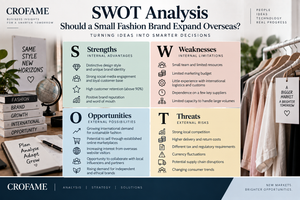
These tools answer different questions. SWOT asks what the company does well, where it is weak and which opportunities and threats surround it. Porter’s Five Forces focuses on competitive pressure within an industry. PESTLE looks even further outward at the broader environment.
CIPD specifically recommends using PESTLE alongside tools such as SWOT, Porter’s Five Forces, competitor analysis and scenario planning rather than treating it as a complete strategy on its own. (CIPD)
That combination gives management a wider picture: What is happening inside the company? What is happening in the industry? What is changing in the world around both of them?
A Business Cannot Control the Environment — but It Can Prepare for It
The main value of PESTLE is recognising that business performance does not depend only on internal decisions. A well-managed company can still face weaker demand because the economy changes. A successful product can become less attractive because customer behaviour shifts. A reliable process can become outdated because new technology changes the standard expected by the market.
The UK Government’s Green Book also uses PESTLE as a way of thinking through the wider context surrounding proposed change, covering political, economic, social, technological, legal and environmental influences. (GOV.UK)
A company cannot control most of these forces. It can, however, identify which ones matter, monitor them and prepare alternative responses.
That is the practical purpose of PESTLE: not predicting the future, but reducing the chance that the future takes the business completely by surprise.
Category: Business Theory
Secondary category: Business Strategy
Sources
CIPD — PESTLE Analysis (2025). Defines the six external factors, explains how the framework supports strategic decision-making and recommends using it alongside SWOT, Porter’s Five Forces and scenario planning. (CIPD)
HM Treasury — The Green Book 2026. Identifies PESTLE analysis as one method for understanding the wider political, economic, social, technological, legal and environmental context surrounding proposed change. (GOV.UK)
UK Government — The Futures Toolkit. Uses PESTLE as a framework for organising external drivers that can shape future operating and policy environments. (GOV.UK)