
Anna

Why Interest Rates Affect Businesses — Even Without a Business Loan

Interest rates do not affect only companies that borrow money. They influence how much consumers spend, whether businesses invest, how suppliers finance their operations and how attractive saving becomes. This means a debt-free company can still experience the effects of higher rates through weaker customer demand, higher supplier costs or slower economic activity. The Bank

Why Interest Rates Affect Businesses — Even Without a Business Loan Read More »
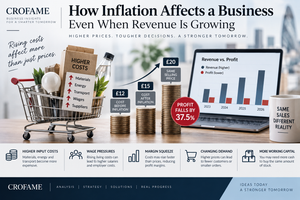
How Inflation Can Hurt a Business Even When Revenue Is Growing

Revenue growth usually looks positive. If a company sells more this year than last year, management may assume the business is becoming stronger. During periods of inflation, however, higher revenue does not necessarily mean higher profitability. A company can collect more money from customers while simultaneously paying more for materials, wages, energy, transport and other

How Inflation Can Hurt a Business Even When Revenue Is Growing Read More »

When Growth Lowers Costs — and When It Starts Costing More

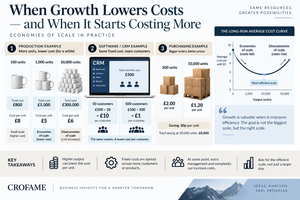
When Growth Lowers Costs — and When It Starts Costing More Growth is usually seen as a sign that a business is becoming stronger. More customers, more production and higher sales can allow a company to negotiate better prices, use equipment more efficiently and spread fixed costs across a larger number of products or customers.

When Growth Lowers Costs — and When It Starts Costing More Read More »

Which Jobs Can Technology Replace — and Which Still Need People?

Which Jobs Can Technology Replace — and Where Will People Still Be Needed? Automation does not affect every job in the same way. Some tasks can already be completed almost entirely by software or machines, while others are more likely to become faster and easier with AI support. The International Labour Organization estimates that one

Which Jobs Can Technology Replace — and Which Still Need People? Read More »

Automation Should Support People, Not Just Replace Tasks

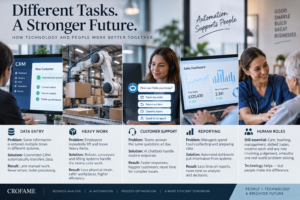
Automation Should Support People, Not Just Replace Tasks Automatyzacja jest często przedstawiana jako sposób na zastępowanie ludzi technologią, ale w wielu firmach jej największa wartość wygląda inaczej. Roboty, maszyny i oprogramowanie mogą przejąć zadania ciężkie, powtarzalne, ryzykowne albo bardzo czasochłonne, pozostawiając ludziom pracę wymagającą oceny sytuacji, komunikacji i podejmowania decyzji. Dobrym sposobem na napisanie tego

Automation Should Support People, Not Just Replace Tasks Read More »

AI Can Be Fast and Wrong: Why Human Oversight Still Matters in Business

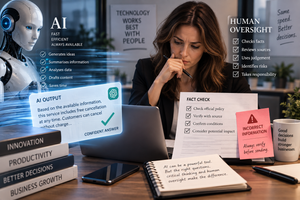
Artificial intelligence can complete tasks in seconds that would previously have taken employees hours. It can summarise documents, analyse information, draft customer responses, classify data and identify patterns across large datasets. That speed creates obvious opportunities for businesses, but it also introduces a simple risk: an answer can be produced quickly without necessarily being correct.

AI Can Be Fast and Wrong: Why Human Oversight Still Matters in Business Read More »

Bad Management Costs More Than Businesses Realise

When the Workplace Becomes the Problem: How Poor Management Damages Performance Businesses often look for performance problems in the wrong place. When productivity falls, deadlines are missed or employees begin leaving, management may assume the company needs more training, better technology or stricter targets. Sometimes, however, the real problem is the working environment itself. Poor

Bad Management Costs More Than Businesses Realise Read More »

Why Inefficient Processes Cost More Than Businesses Realise

Why Inefficient Processes Cost More Than Businesses Realise Most inefficient processes do not look dramatic. There is rarely one obvious mistake costing the company thousands of pounds at once. Instead, the cost appears in small activities repeated every day: entering the same information twice, waiting for approval, searching for documents, correcting errors, chasing colleagues for

Why Inefficient Processes Cost More Than Businesses Realise Read More »

Why Digital Transformation Fails Even When the Technology Works

Why Digital Transformation Fails Even When the Technology Works A company can buy excellent software, migrate its data successfully, connect all the required systems and still fail to achieve digital transformation. The technology may work exactly as promised, yet employees continue using spreadsheets, customers experience the same delays, managers still request manual reports and productivity

Why Digital Transformation Fails Even When the Technology Works Read More »

Work-Life Balance Is Not a Luxury: What Maslow’s Hierarchy Can Teach Us About Sustainable Performance

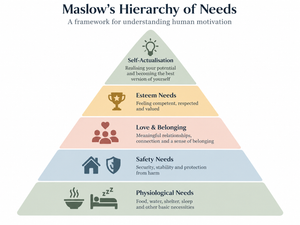
Modern working life often rewards visible productivity. Long hours, constant availability and packed schedules can create the impression that someone is highly committed and successful. But productivity is difficult to sustain when sleep, health, relationships, financial security or basic recovery are continually neglected. This is where the idea of self-care becomes more useful than it

Work-Life Balance Is Not a Luxury: What Maslow’s Hierarchy Can Teach Us About Sustainable Performance Read More »

Where AI Actually Creates Value in Small Businesses — and Where It Doesn’t

Artificial intelligence has quickly moved from being a specialist technology to something almost any business can access. A small company can now use AI to draft documents, analyse information, respond to customers, summarise meetings, create marketing content or automate repetitive administrative work without building its own technology department. Adoption is growing quickly. OECD data published

Where AI Actually Creates Value in Small Businesses — and Where It Doesn’t Read More »

Shopping Cart